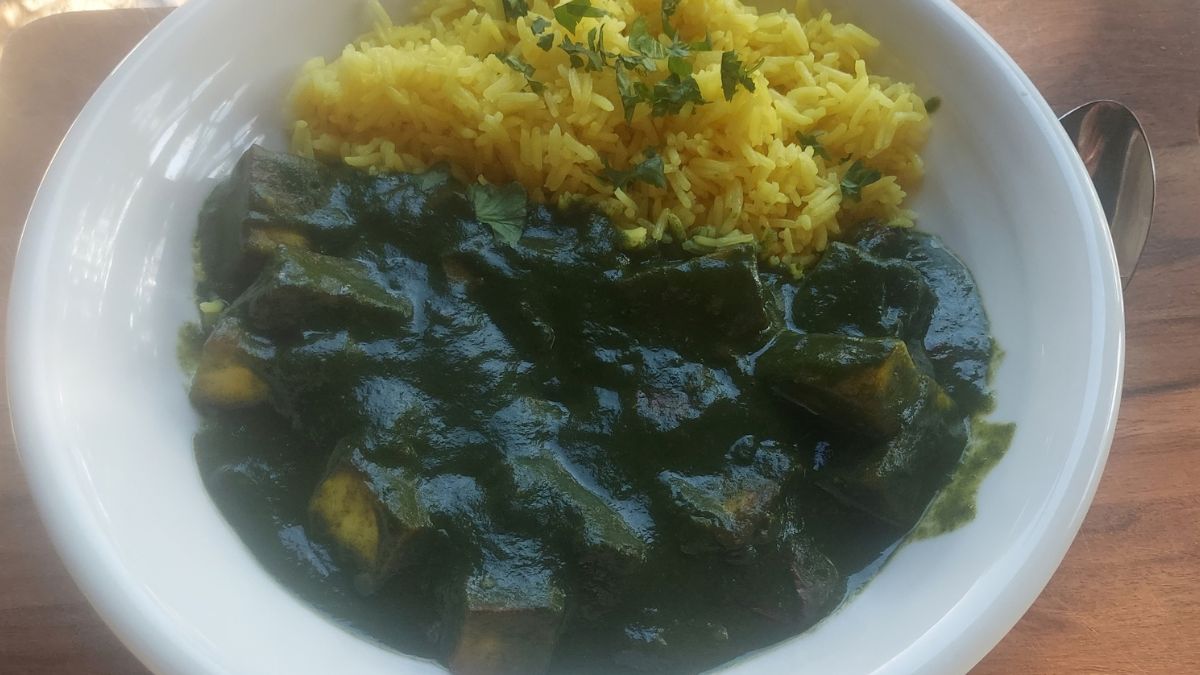
I love Saag Paneer curry. Pretty much every kind I’ve tried so far, although there are so many different curries in the world that thankfully, I still have a lot ahead of me. I love how completely different two dishes can be while both being called curry. Different spices, different textures, different levels of heat and completely different traditions behind them.
My interest in curry really started when I was living in the UK and working in one of the larger hotels. One of the experienced chefs there introduced me to a completely different world of spices and flavours. He had very little connection to India or any of the countries where curry is part of everyday food culture, but I have to give him credit, he made very good curry. That was where my curiosity started. I began trying different recipes at home and learning what individual spices actually did rather than simply adding curry powder to a pan.
Saag paneer came a little later, when I was looking for a good vegetarian curry. I wanted something green and substantial, something that would make a proper dinner without anyone sitting at the table wondering where the meat was. I found a recipe written by someone who had grown up eating the dish, so naturally I wanted to try it the way they made it first. I loved the flavour, but the amount of fat was simply too much for me. There was plenty of ghee for cooking the spinach, more for frying the paneer and then more fat used in preparing the rice. By the time everything came together, it was a very rich meal and I could definitely feel it afterwards.
I have absolutely nothing against ghee. I use it myself and think it deserves its place in the kitchen. I just don’t need large amounts of it at every stage of one meal. Over time I started changing the recipe, not because I wanted to turn saag paneer into some sort of low-fat curry, but because I wanted to keep making a dish I loved in a way that suited me better. I kept the paneer, kept the richness and kept the flavours, but changed how some of the ingredients were prepared.
Instead of frying the paneer in plenty of ghee, I now cut it into cubes, drizzle it with a little extra virgin olive oil and season it with salt, sweet paprika and a small amount of turmeric. Then I bake it until it begins to colour around the edges. Sometimes I use ghee for the curry and sometimes EVOO. For me, this isn’t about removing fat from food or replacing real ingredients with light versions. It’s simply about using enough to make the food taste good without making the entire meal unnecessarily heavy.
Saag Doesn’t Actually Mean Spinach
Something I didn’t know when I first started making this dish is that saag doesn’t actually mean spinach. The word refers more broadly to leafy greens and has very old linguistic roots connected with the Sanskrit śāka, meaning greens or leafy vegetables. Depending on the region, season and the person cooking, saag can be made with mustard greens, spinach, fenugreek leaves, amaranth and other leafy vegetables.
One of the best-known examples is sarson ka saag, particularly associated with Punjabi cuisine, where mustard greens traditionally take centre stage. Palak, on the other hand, specifically refers to spinach. So palak paneer and saag paneer aren’t technically quite the same thing, even though outside South Asia you’ll often see the names used rather loosely.
My version is predominantly spinach, but saag paneer is the name under which I first discovered this dish and the name that has stayed with it in our house. I’m not trying to present my version as the traditional way saag paneer has to be made. It started with a traditional idea, I learned from it, and over the years it simply became the version that works in my own kitchen.
How Old Is Saag Paneer?
There isn’t a neat date we can point to and say that this was the day someone invented saag paneer. Saag and the tradition of cooking leafy greens have deep roots across the Indian subcontinent, while paneer has a long and slightly debated history of its own. Historical descriptions from roughly AD 75–300 mention a solid mass produced from heated milk and curd that researchers have compared with paneer. There are also theories that Persian, Afghan and Central Asian cheesemaking traditions influenced the paneer that later became established in northern India.
I actually find that more interesting than a perfect origin story. Food rarely develops in one kitchen on one particular day. Ingredients move between regions, cooking techniques travel and generations adapt dishes according to what grows around them and what they have available. Eventually a dish can feel as though it has always existed, even when its individual parts have their own complicated histories.
Paneer itself is an interesting cheese because of the way it’s made. Milk is heated and coagulated with acid, the curds are separated from the whey and then pressed together. It doesn’t need to be aged, and unlike cheeses such as mozzarella or cheddar, paneer holds its shape remarkably well when heated. That’s exactly what makes those cubes work so well in a curry, whether they’re fried, grilled or, in my case, baked before being added to the spinach.
How I Make My Saag Paneer
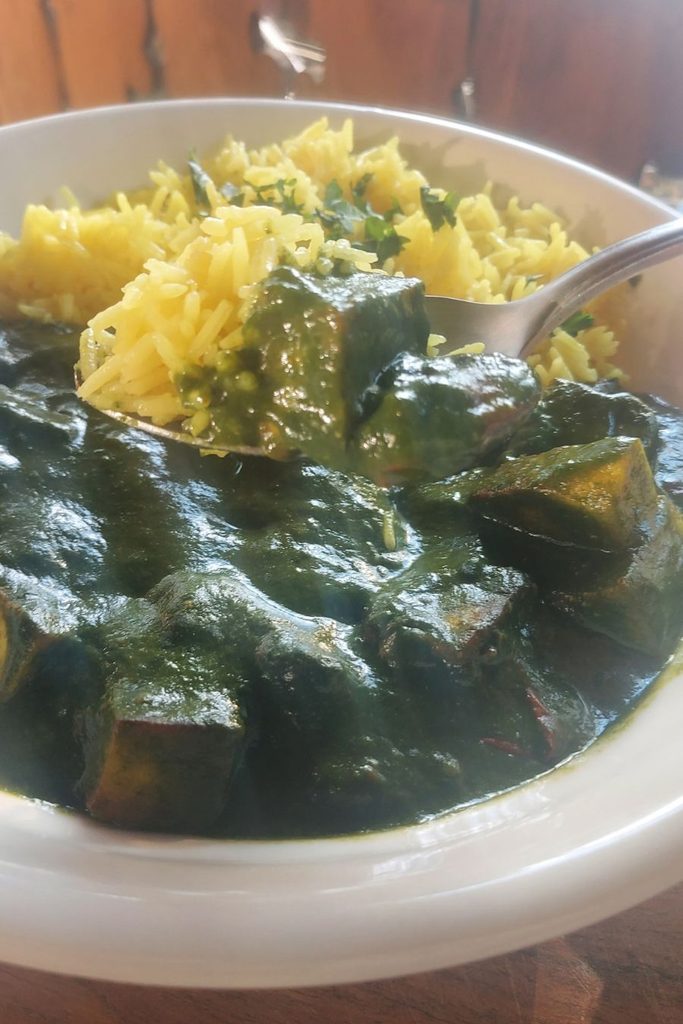
When I make saag paneer for my family, I make enough for around six portions. I use roughly 600 g of fresh spinach and about 1 kg of paneer. It might sound like a lot of cheese, but I want paneer to be a proper part of the meal, not five little cubes hiding somewhere in a large pan of spinach.
I start with roughly chopped onion, which I gently cook in ghee or extra virgin olive oil before adding minced garlic. Then the washed spinach goes into the pan along with the spices. At first it looks like an enormous amount of spinach, but I cover the pan and let it collapse down, then continue cooking until a good amount of the water it releases has evaporated. Adding the spices at this stage also gives them time to warm through and release their aroma into the spinach.
Once the spinach has reduced properly, I blend it and return it to the pan. I prefer doing it this way rather than blending a very wet mixture because I don’t want a thin green sauce. I want it thick enough to coat the paneer. I then add fresh tomatoes cut into wedges and around 250 ml of my homemade curry base gravy, which I make from peppers, tomatoes, onions, garlic, curry spices, salt and coriander.
I don’t always have my base gravy ready, though. If there isn’t any in the freezer, I use some of my homemade bone broth instead. Obviously, the moment I do that the dish is no longer vegetarian, but for us at home that’s absolutely fine. It’s one of those practical substitutions that happened because I used what I already had, liked the result and kept doing it.
While the spinach is cooking, I prepare the paneer separately. I cut it into cubes, drizzle it with EVOO and season it with salt, sweet paprika and turmeric. I’m quite careful with turmeric because more isn’t necessarily better. Too much can dominate everything else and bring an unpleasant bitterness. The paneer then goes into a 180°C fan oven until the outside has taken on some colour while the inside stays soft.
The rice gets a little attention too. I rinse it several times until the water runs clear, then leave it to drain properly in a sieve. In the pot I warm some EVOO with turmeric, cardamom pods, three bay leaves and salt before adding the drained rice. I let the grains cook briefly with the spices, then add boiling water and cook everything covered. Plain rice would obviously work, but I like the rice to bring something to the meal rather than simply sitting underneath the curry.
Is Saag Paneer Really an Iron-Rich Meal?
Spinach has been associated with iron for so long that it’s easy to look at a curry containing 600 g of it and immediately think of iron. Spinach certainly contains non-haem iron, but the amount of a mineral present in a food and the amount our bodies can actually absorb aren’t necessarily the same thing. The food matrix, preparation and other components of the meal can all influence what eventually becomes available to us.
Oxalates are often given almost all of the blame for iron from spinach being poorly absorbed, but the research is more nuanced than that. Human research looking specifically at oxalic acid found its effect on non-haem iron absorption to be relatively small. Calcium is a clearer example of why bioavailability matters. Spinach contains quite a lot of calcium when we look at its nutritional composition, but we absorb relatively little of it compared with calcium from dairy because much of the calcium in spinach is bound within the plant matrix, including to oxalate.
That doesn’t make spinach any less interesting nutritionally. It gives us folate, vitamin K1 and carotenoids including beta-carotene and lutein, and this is where the rest of the ingredients in the meal start to matter. Beta-carotene and lutein are fat-soluble carotenoids, so having some fat in the meal from the paneer, ghee or olive oil can improve their absorption. The tomatoes bring another carotenoid, lycopene, and cooking tomatoes can actually make lycopene more bioavailable. Having them in a meal containing some fat can help with carotenoid absorption too.
Paneer brings something quite different to the plate. It provides high-quality protein as well as a much more bioavailable source of calcium, along with phosphorus and dairy nutrients such as vitamin B12 and riboflavin. So although spinach contains calcium on paper, the paneer is doing much more of the work when it comes to providing readily absorbable calcium in this meal.
This is one of the things I find most interesting about nutrition. Cooking doesn’t automatically make food less nutritious, fat isn’t automatically something that should be removed, and seeing a nutrient listed in a food doesn’t tell us exactly how much our bodies will use. In this meal, fat helps us absorb carotenoids from the vegetables, cooking improves the availability of lycopene from the tomatoes, while some minerals in spinach are less available than their numbers on a nutrition table might suggest. Iron may be the nutrient we immediately associate with spinach, but saag paneer has much more to offer than its iron content alone.
A Recipe That Changed With Me
My saag paneer today isn’t exactly the one I first discovered all those years ago, and I’m perfectly happy with that. That original recipe introduced me to a dish I might otherwise never have cooked, and I still appreciate where it started. Over time I simply kept what I loved and changed the parts that didn’t work quite as well for me.
I bake the paneer rather than frying it in lots of ghee, use enough fat to cook everything properly without making the whole meal too heavy, and add fresh tomatoes and a little lemon to balance the richness. If I have my curry base gravy, that’s what goes in. If I don’t, some homemade bone broth comes out of the freezer instead. I serve it with my spiced rice and fresh coriander, and that’s the version my family now knows.
I think that’s how many recipes eventually become part of our own kitchens. We discover something, make it the way someone else taught us, learn what we like about it and gradually begin cooking it without looking back at the recipe that introduced us to it. My saag paneer has changed along the way, but it still reminds me why I became so interested in curry in the first place. There isn’t one curry or one way of making it. There are countless regional dishes, family recipes, combinations and flavours that I still haven’t tasted, and thankfully I still have plenty left to discover.
I love curry. Pretty much
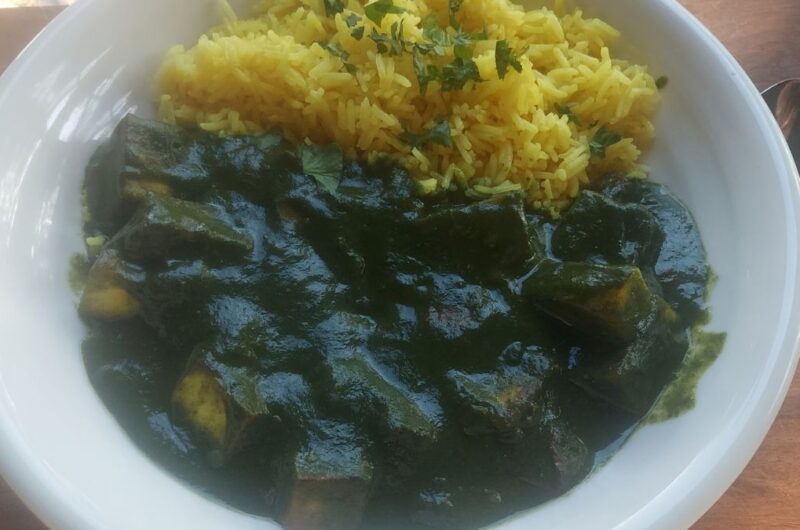
Saag Paneer – The Curry That Became My Own
Course: Main CourseCuisine: Indian – InspiredDifficulty: Easy6
servings20
minutes40
minutes580
kcalIngredients
For the paneer
600 g paneer, cut into cubes
1 tbsp extra virgin olive oil
1 tsp sweet paprika
½ tsp turmeric
½ tsp salt
For the saag
600 g fresh spinach
1 large onion
3 garlic cloves, minced
1 tbsp ghee or extra virgin olive oil
3 medium tomatoes, cut into wedges
250 ml homemade curry base gravy or homemade bone broth*
1 tsp ground cumin
chilli, to taste
chilli, to taste
squeeze of fresh lemon juice
fresh coriander, to finish
For the rice
1 tsp extra virgin olive oil
½ tsp turmeric
4–5 cardamom pods
lightly crushed 3 bay leaves
water for cooking
Directions
- Prepare the paneer. Preheat the oven to 180°C fan. Cut the paneer into bite-sized cubes and place them in a bowl. Add the EVOO, sweet paprika, turmeric and salt, then gently toss until the pieces are evenly coated. Spread them on a baking tray in a single layer and bake for around 18–20 minutes, turning halfway through, until lightly golden around the edges. Don’t leave it too long, as paneer can become dry and rubbery.
- Start the saag. Roughly chop the onion and gently cook it in the ghee or EVOO over medium heat until softened and translucent. Add the minced garlic and cook briefly, just until fragrant. Add the washed spinach, ground cumin, chilli and a little salt. Cover the pan for a few minutes to help the spinach collapse, then remove the lid and continue cooking until it has reduced considerably and much of the water released by the spinach has evaporated.
- Blend the spinach. Once the spinach has cooked down and isn’t too watery, blend it until you have a fairly smooth green sauce. Return it to the pan, add the curry base gravy or bone broth and stir everything together. Add the tomatoes cut into wedges and cook gently for around 10 minutes, allowing the tomatoes to soften while still keeping some of their shape.
- Cook the rice. While the saag is cooking, rinse the basmati rice several times until the water runs clear, then drain it well in a sieve. Heat the EVOO in a saucepan and add the turmeric, cardamom pods, bay leaves and salt. Let the spices warm briefly, then add the drained rice and gently stir for about 1 minute so the grains are coated with the oil and spices. Add boiling water, cover and cook according to the rice you’re using, keeping the lid on while it cooks.
- Bring everything together. Add the baked paneer to the finished saag and gently fold it through the sauce so you don’t break the cubes. Let everything cook together for another 2–3 minutes, just long enough for the paneer to warm through and take on some of the flavour of the sauce. Finish with a squeeze of fresh lemon juice, taste for salt and chilli, then scatter generously with fresh coriander.
- Serve. Spoon the fragrant turmeric and cardamom rice onto the plates and serve the saag paneer alongside or over the top. Finish with a little more fresh coriander and lemon if you like.
Notes
- Paneer: Keep an eye on it in the oven. You want lightly golden edges while the centre stays soft. Overbaking can make paneer dry and rubbery.
Turmeric: A little goes a long way. Too much can give both the paneer and rice a bitter flavour.
Spinach: Let most of the water released by the spinach evaporate before blending. This gives you a thicker, richer saag rather than a watery sauce.
Base gravy: I use my homemade curry base gravy when I have it. Homemade bone broth works well as a substitute, but remember that the dish will no longer be vegetarian.
Rice: Rinse it until the water runs clear and drain it well before adding it to the spices.
Heat: Adjust the chilli to your taste. I keep mine fairly mild so everyone in the family can enjoy it.
Lemon: Add it at the end rather than cooking it for a long time. It freshens the whole dish and balances the richness of the paneer.