This Greek moussaka recipe has been part of our family dinners for years, although I honestly can’t remember when I first started making it. I probably saw a recipe somewhere on YouTube or online, thought it looked good and decided to make it. There’s no story about discovering it in a little Greek taverna either. I’ve never actually been to Greece.
To me, moussaka has always felt a little like the Greek version of lasagne. Not because they’re the same dish, but because they give me that same kind of feeling. You build everything in layers, there’s a rich meat sauce, vegetables, a creamy béchamel on top, and it all goes into the oven until it’s golden. It’s proper comfort food.
Somewhere along the way, it became one of those dinners my family gets genuinely excited about. I’ve made it for friends too, and that’s where things got quite funny. I’ve had someone tell me, “I’ve been to Greece and I didn’t like moussaka there,” and then really enjoy mine. I’ve also heard, “I don’t like aubergine,” or even “I’ve never liked aubergine,” only for them to discover that apparently aubergine wasn’t the problem after all.So here I am. I’ve never been to Greece, I have absolutely no Greek grandmother who passed this recipe down to me, and somehow I’ve still managed to convert a few moussaka and aubergine sceptics. I’ll take that.
The Greek Moussaka Recipe I Make at Home
My version has everything I want from this kind of dinner: soft aubergine, golden potatoes, a rich tomato and meat sauce, then a thick layer of béchamel with egg yolks and Parmigiano Reggiano. There’s more Parmigiano on top before it goes into the oven, because that’s the kind of detail I’m definitely not going to skip.
I usually bake the aubergine rather than fry it. I slice it, salt it and leave it for a while, then pat away the moisture and bake the slices on an oiled tray until they’re soft and have a little colour. They don’t need to be deeply browned. I just want them soft and ready to become part of those layers rather than tasting like completely separate pieces of aubergine.
The potatoes can go one of two ways. Sometimes I boil them first, slice them and fry them. Other times I slice them, arrange them on a tray and let the oven do the work until they start getting some colour. Both work, so it normally depends on how I feel and how many pans I want to deal with that day.
The Little Change We Ended Up Preferring
There is one ingredient in my meat sauce that isn’t traditional: pomegranate molasses.Red wine is the more traditional choice, and I still use it sometimes.But over the years, my Greek moussaka recipe has slowly become the version my family likes best. Over time I also started making the sauce with pomegranate molasses, and it turns out we actually prefer it that way. It brings sweetness, acidity and a deeper flavour to the tomato and meat without making the sauce taste like pomegranate.
If I have red wine and feel like using wine, I’ll use that. If I have pomegranate molasses, that’s usually the bottle I reach for.
That’s probably one of the things I enjoy most about recipes I’ve been making for years. At some point you stop following somebody else’s instructions word for word. You know what the dish is supposed to be, but you also know how you like it.
This is how I like my moussaka.
And Then I Took Moussaka to the Nursery
When I worked as a nursery cook, I ended up making a version of moussaka there too. Of course, feeding very young children is quite different from putting dinner on the table at home. You can’t necessarily take exactly the same recipe, serve it to a room full of little people and expect everyone to be thrilled about the aubergine sitting on their plate. Those guys needed their own version.
I changed some of the ingredients and adapted the way I prepared it, while keeping the idea of moussaka and those lovely layers. I still wanted it to be recognisable as a proper meal and, most importantly, I still wanted it to taste good. Making food suitable for young children never meant to me that everything interesting had to disappear from the plate.And apparently the little people agreed. Before I left the nursery, there were a few requested dinners that people wanted me to make again while I was still there. Moussaka was one of the last ones I made.
That adapted nursery version is now one of the recipes in my The First Taste ebook. It’s slightly different from the moussaka I’m sharing here, both in the ingredients and in the way I prepare it, so I’m keeping the two as separate recipes rather than repeating the nursery version on the blog.
Building the Layers
Once everything is prepared, the moussaka comes together in four layers: aubergine, potatoes, meat sauce and finally that thick béchamel. I finish it with another handful of freshly grated Parmigiano Reggiano before it goes into the oven.
For me, the béchamel is an important part of the whole thing. I make mine with egg yolks, a little nutmeg and mustard, and Parmigiano Reggiano mixed into the sauce. I want it rich and creamy, with enough body to sit properly on top of the meat rather than disappearing into the layers underneath.
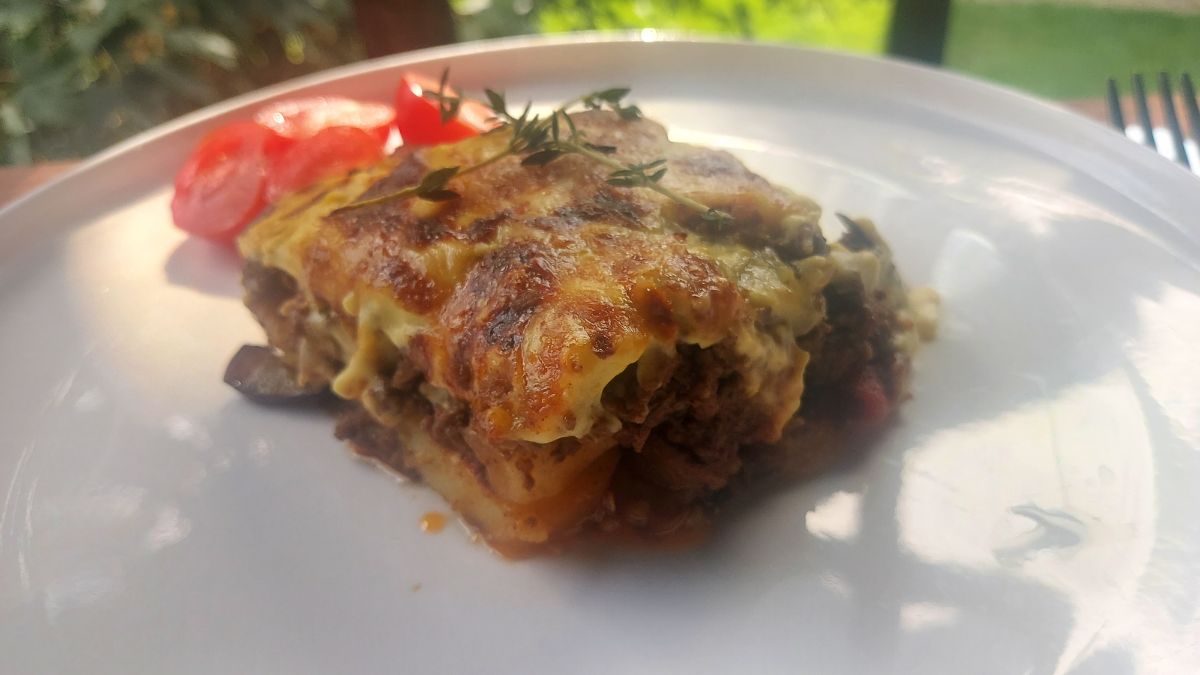
Once baked, you get soft aubergine and potatoes underneath, rich meat sauce in the middle and that golden, cheesy béchamel on top. It’s exactly the kind of dinner that makes sense to me when I think of moussaka as Greece’s answer to lasagne.
Maybe one day I’ll finally go to Greece and eat my way through enough moussaka to find out how mine compares. Until then, this is the version I’m making at home. And considering it’s already managed to win over a few people who were quite sure they didn’t like moussaka, or aubergine, I think I’ll keep making it exactly this way.
I’ve Never Been to Greece, But This Is My Greek Moussaka Recipe
Course: DinnerCuisine: GreekDifficulty: Medium8
servings40
minutes1
hour20
minutes550
kcalIngredients
1 medium onion
2 garlic cloves
2 tbsp olive oil
900 g minced beef or lamb
1 chopped tomatoes
3 tbsp tomato paste
salt
black pepper
3 tbsp pomegranate molasses or red wine
Potato layer
600–700 g potatoes
2 medium aubergines
Béchamel
2 tbsp olive oil
2 tbsp plain flour
500 ml milk
pinch of nutmeg
½ tsp mustard
salt
black pepper
2 egg yolks
a handful of finely grated Parmigiano Reggiano
Directions
- Prepare the aubergines.
Slice the aubergines, sprinkle them with salt and leave for about 20 minutes. Pat the slices dry with paper towels, then arrange them on a lightly oiled baking tray. Bake for about 20 minutes, until softened and starting to take on a little colour, or fry them in olive oil until golden-brown . They don’t need to be deeply browned. Set aside - Prepare the potatoes.
Boil the potatoes until just tender, making sure they are still firm enough to slice without falling apart. Allow them to cool slightly, then cut into slices. Either lightly fry the slices until golden, or arrange them on a lightly oiled baking tray and bake until lightly golden. Set aside. - Make the meat sauce.
Heat the olive oil in a large pan. Add the onion and cook until softened, then add the garlic and cook briefly. Add the minced meat and cook until browned, breaking it up with a spoon as it cooks.
Finish the meat sauce.
Add the tomatoes and tomato paste, then season with salt and black pepper. Add the pomegranate molasses or red wine. Cook until the sauce has reduced and thickened, stirring occasionally. Set aside while you make the béchamel. - Make the béchamel.
Heat the olive oil in a saucepan, then add the flour. Cook for a short time, stirring, until the flour begins to change colour slightly. Don’t let it burn.
Add the milk.
Gradually pour in the milk, a little at a time, stirring well after each addition before adding more. Continue cooking and stirring until the sauce is smooth and thickened. Season with nutmeg, mustard, salt and black pepper.
Finish the béchamel.
Remove the saucepan from the heat. Add the egg yolks one at a time, mixing thoroughly after each addition. Stir in a handful of grated Parmigiano Reggiano until combined. - Assemble the moussaka.
Arrange the aubergine slices in an even layer over the bottom of an ovenproof dish. Add the potatoes, followed by the meat sauce. Spread the béchamel evenly over the top and finish with another handful of grated Parmigiano Reggiano. - Bake.
Bake at 180°C for about 30 minutes, until the moussaka is piping hot and the top is golden. - Rest before serving.
Let the moussaka rest for a little while before slicing and serving. This gives the layers time to settle and makes it easier to cut into portions.
Notes
- Pomegranate molasses or red wine: I use either in the meat sauce, but my family prefers the pomegranate molasses version. It adds a lovely balance of sweetness and acidity. Pomegranate molasses is my own twist rather than a traditional moussaka ingredient.
Aubergines: You can either bake or fry the slices. Frying gives them a deeper golden-brown colour and richer flavour, while baking is convenient when you’re preparing a larger batch.
Potatoes: Pre-boil them before either frying or baking. Cook them until just tender but still firm enough to slice without falling apart.
Béchamel: Remove it from the heat before adding the egg yolks. Add them one at a time, mixing well after each addition.
Resting: Let the moussaka rest for around 15–20 minutes after baking. This helps the layers settle and makes it much easier to slice and serve.