
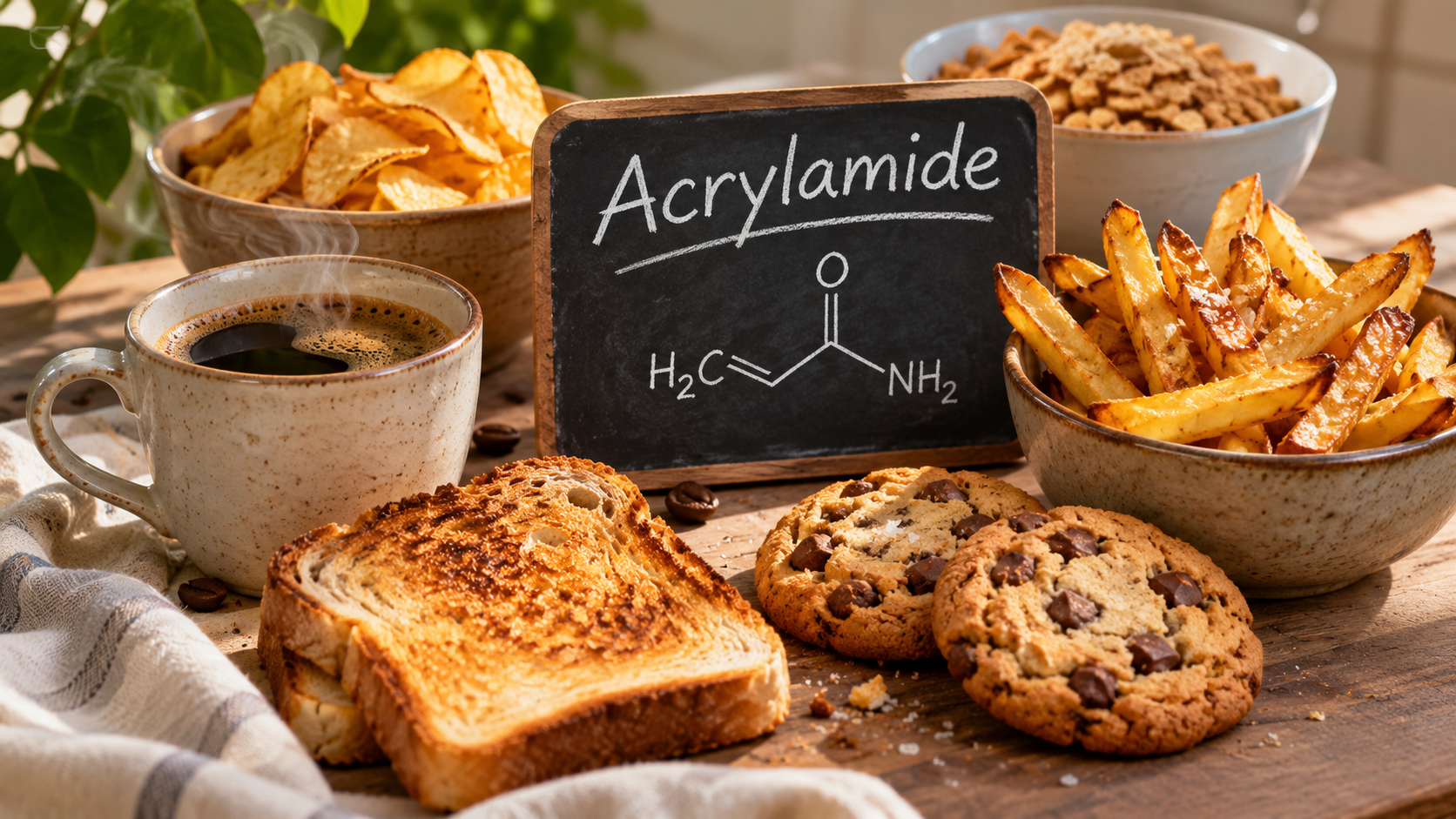
From golden toast and crispy potatoes to coffee and freshly baked biscuits, what really happens to our food when we cook it, and what does science tell us about the possible health effects?
There is something wonderfully familiar about the smell of toast in the morning, potatoes turning golden in the oven, or a tray of freshly baked biscuits cooling on the kitchen counter. Much of what makes these foods so appealing comes from the chemical reactions that take place when we cook them, creating the colours, flavours and aromas we associate with some of our favourite meals. Yet those same reactions can sometimes produce compounds we might prefer to consume in smaller amounts. Acrylamide in everyday food is one of those subjects that deserves a closer look, not because every browned crust should worry us, but because understanding what happens during cooking can help us make more informed choices.
I first became particularly interested in acrylamide while researching my article Coffee Chemistry: What’s Really in Your Cup?, where I explored laboratory measurements of this compound in roasted coffee. What surprised me wasn’t simply that acrylamide could be found in coffee, but how many other familiar foods contributed to our exposure. Toast, crackers, breakfast cereals, biscuits and roasted potatoes can all contain it, even when they are prepared at home using ordinary ingredients. That made me curious about the bigger picture: how much do we actually consume, what happens once it enters our bodies, and what do scientists really know about its long-term effects?
How Does Acrylamide Form, and Which Foods Contain It?
Acrylamide is a small, water-soluble organic compound that can form when certain foods are exposed to high temperatures, particularly during frying, roasting and baking. Its formation mainly involves asparagine, an amino acid naturally present in many plant foods, and reducing sugars such as glucose and fructose. When these substances are heated, especially above approximately 120°C in relatively dry conditions, they can react as part of the Maillard reaction. This is the same broad family of chemical reactions responsible for the attractive golden colour of bread, the toasted flavour of biscuits and the delicious aroma of roasted potatoes.
Scientists first reported the widespread presence of acrylamide in heated foods in 2002, following research in Sweden, although the compound almost certainly existed in cooked foods long before its discovery. It is particularly associated with carbohydrate-rich plant foods, including potato crisps, French fries, bread, crackers, biscuits, breakfast cereals and coffee. Roasted chicory, cereal-based coffee substitutes and certain foods intended for babies and young children can also contain measurable amounts. Interestingly, acrylamide is generally much less prominent in meat, fish and dairy products, although high-temperature cooking of these foods can produce other compounds through different chemical pathways.
What makes acrylamide particularly interesting is how strongly its concentration can depend on preparation. A boiled potato and a portion of deeply browned chips may begin with the same ingredient, yet the chemical reactions occurring during cooking are very different. Boiling and steaming generally produce little acrylamide because the food remains in a moist environment, while dry heat encourages the browning reactions responsible for its formation. Even within the same food category, differences in ingredients, moisture, temperature and cooking time can lead to considerable variation.
What Have Laboratories Actually Found in Everyday Foods?
Rather than relying on general statements about which foods contain acrylamide, I wanted to look at what laboratories had actually measured. The US Food and Drug Administration (FDA) has published extensive surveys of acrylamide in retail foods, including results from its Total Diet Study. These measurements provide a useful picture of how widely concentrations can vary, although they should not be interpreted as permanent values for particular products. Recipes, ingredients and manufacturing conditions change over time, and even different batches of the same food may contain different amounts.
The following examples are selected historical measurements published by the FDA. They show the concentrations detected in specific tested samples, rather than current averages for entire food categories.
| Food tested | Acrylamide |
|---|---|
| Fast-food French fries | 446 µg/kg |
| Potato crisps | 428 µg/kg |
| Chocolate chip cookies | 150 µg/kg |
| Graham crackers | 687 µg/kg |
| Butter-type crackers | 252 µg/kg |
| Corn flakes | 69 µg/kg |
| Toasted plain bagel | 61 µg/kg |
| Whole-wheat bread | 67 µg/kg |
| Baked potato with skin | 66 µg/kg |
Source: FDA Total Diet Study, selected historical food measurements. These figures represent individual samples and should not be treated as current product averages.
At first glance, the difference between 69 µg/kg in one breakfast cereal sample and 687 µg/kg in one cracker sample may seem enormous. However, these measurements describe the amount per kilogram of food, not the amount someone would consume in a typical serving. If a product contains 400 µg/kg of acrylamide, a 30 g portion would provide approximately 12 µg, while a 150 g portion at the same concentration would provide around 60 µg. This distinction is important because our actual exposure depends on both the concentration in a food and how much of it we eat.
The FDA also published an interesting comparison of bread products before and after toasting. In one historical test, Pepperidge Farm Original White Bread contained 36 µg/kg before toasting and 216 µg/kg afterwards, while Sara Lee Plain Mini Bagels increased from 58 to 343 µg/kg in the tested samples. That is a substantial difference for something as ordinary as putting bread in a toaster, and it demonstrates how much the cooking process itself can influence the result. It doesn’t mean every slice of toast will show the same increase, but it does explain why the degree of browning matters.
How Much Acrylamide Do We Actually Consume?
Most of us don’t consume acrylamide from just one food. We might have toast and coffee for breakfast, a few biscuits during the afternoon and roasted potatoes or chips with dinner, with each contributing a different amount. Our total exposure therefore depends on the foods we choose, their preparation, the size of our portions and how frequently we eat them. This makes dietary exposure considerably more complicated than simply identifying which products contain acrylamide.
In its comprehensive 2015 assessment, the European Food Safety Authority (EFSA) analysed more than 43,000 food measurements and estimated average dietary exposure across population groups at approximately 0.4–1.9 micrograms per kilogram of body weight per day. Higher-end exposure estimates ranged from approximately 0.6 to 3.4 µg/kg of body weight per day. These figures describe estimated exposure across different populations and age groups, rather than recommended intakes or established safety limits. They also illustrate why body weight matters when comparing the same amount of acrylamide consumed by different people.
To put these measurements into perspective, consider an illustrative day using selected historical FDA concentrations. The following calculation combines measurements from different food samples to demonstrate how exposure can add up, rather than representing a typical or measured daily diet.
| Food eaten | Portion | Estimated acrylamide |
|---|---|---|
| Toasted bread | 60 g | 12.96 µg |
| Prepared coffee | 250 ml | 2.00 µg |
| Chocolate chip cookies | 40 g | 6.00 µg |
| French fries | 150 g | 66.90 µg |
| Illustrative daily total | 87.86 µg |
Calculated using historical FDA concentrations of 216 µg/kg for toast, 8 µg/kg for prepared coffee, 150 µg/kg for cookies and 446 µg/kg for fries. The coffee calculation assumes 250 ml weighs approximately 250 g. This example is illustrative, not a population-average exposure estimate.
For someone weighing 60 kg, this hypothetical total would equal approximately 1.46 µg/kg of body weight, while for someone weighing 80 kg it would be around 1.10 µg/kg. Notice how strongly the French fries influence the result, even though several other foods contribute to the total. That doesn’t mean every portion of fries contains this amount, but it shows why certain foods and cooking methods can make a greater contribution than others. It also explains why I find it more useful to look at overall dietary patterns than to become overly concerned about an occasional slice of toast.
What Happens to Acrylamide Once It Enters the Body?
After we consume acrylamide, it is readily absorbed through the digestive tract and distributed throughout the body, where several metabolic pathways influence what happens next. One involves glutathione, a molecule that participates in the body’s normal processing of reactive substances, while another involves an enzyme called CYP2E1. This enzyme converts a portion of acrylamide into glycidamide, a reactive metabolite that has attracted particular attention in toxicological research. Glycidamide can interact with DNA and form DNA adducts, which are chemical modifications capable of contributing to genetic mutations.
The balance between these metabolic pathways is not necessarily identical in everyone. Genetics, age, smoking and other biological factors can influence how compounds are processed, although researchers cannot reliably predict an individual’s health risk from a particular meal. Understanding these pathways is important because the biological effects of a substance depend not only on the amount entering the body, but also on how it is transformed. In the case of acrylamide, its conversion into glycidamide helps explain why scientists continue to investigate its potential carcinogenic effects.
One question I find especially interesting is whether acrylamide accumulates in the body over time. Unlike certain heavy metals, such as cadmium, acrylamide is not generally considered a contaminant that remains stored in tissues for decades. Human experimental studies show that it is metabolised relatively quickly, with much of the absorbed dose eventually eliminated through urine as metabolites. In one controlled study, the estimated urinary elimination half-life of acrylamide was approximately 3.1–3.5 hours, although this measurement should not be confused with the disappearance of every biological effect associated with exposure.
Acrylamide and glycidamide can also bind to haemoglobin in red blood cells, forming what researchers call haemoglobin adducts. Because red blood cells circulate for approximately four months, these adducts provide a measurable record of exposure over the preceding weeks and months, even though free acrylamide itself does not remain in the bloodstream for that entire period. A 2022 review examined 86 studies involving 27,966 people from 19 countries and found considerable variation in these biomarkers, with higher levels generally observed among smokers and people with occupational exposure. This distinction is worth remembering: acrylamide is relatively rapidly metabolised, but repeated exposure can still be biologically relevant without the substance accumulating in tissues for years.
What Does Science Tell Us About the Health Effects?
This is where the evidence becomes particularly important, because the effects demonstrated in laboratory animals or people exposed to high concentrations at work cannot automatically be applied to the much smaller amounts normally consumed through food. At the same time, the absence of consistent findings in human dietary studies does not necessarily mean that a potential hazard can be dismissed. Scientists therefore examine several kinds of evidence, including experimental toxicology, human epidemiology and measurements of internal exposure. Each provides a different piece of the picture, and understanding their limitations is essential when interpreting the results.
Cancer and DNA Damage
The strongest reason for concern about dietary acrylamide comes from experimental toxicology. Animal studies have demonstrated that acrylamide exposure can increase the incidence of tumours in several organs, with its metabolite glycidamide believed to play an important role because of its ability to interact with DNA. The International Agency for Research on Cancer (IARC) classifies acrylamide as Group 2A, probably carcinogenic to humans, which identifies a potential cancer hazard rather than predicting the risk associated with eating a particular food. This distinction matters because a substance’s ability to cause cancer under certain conditions does not tell us exactly what will happen at the exposure levels encountered in an ordinary diet.
Human studies have produced a more complicated picture. Many investigations have found no clear association between estimated dietary acrylamide intake and specific cancers, while others have reported possible associations for certain cancer types or population groups. A 2022 systematic review and meta-analysis examined epidemiological evidence involving more than one million participants, with findings varying across cancer sites. One of the difficulties is that dietary questionnaires cannot accurately capture differences in cooking methods, meaning two people reporting similar food consumption may have very different acrylamide exposures.
For these reasons, it would be inaccurate to claim that eating toast or roasted potatoes causes cancer. However, it would also be premature to dismiss acrylamide simply because human observational findings remain inconsistent. The animal evidence, its genotoxic properties and the uncertainty surrounding long-term dietary exposure provide a scientific basis for reducing avoidable amounts. This is an example of where understanding the evidence is more useful than trying to divide foods into completely safe or dangerous categories.
The Nervous System, Reproduction and Development
Acrylamide is also a recognised neurotoxic substance at sufficiently high exposures, with occupational exposure associated with peripheral neuropathy, including tingling, numbness, weakness and impaired coordination. These findings are well established in the context of substantial exposure, but workplace conditions can involve much larger amounts and different routes of contact than ordinary food consumption. EFSA concluded that neurological effects were not the principal concern at estimated current dietary exposure levels, identifying cancer-related effects as the more significant issue. This doesn’t make the neurological evidence irrelevant, but it places it in the appropriate context.
Animal research has also identified possible effects on reproduction and development at sufficiently high doses, including findings involving male reproductive function. Human pregnancy research has raised additional questions, particularly about fetal growth. A 2022 systematic review and meta-analysis involving 53,870 mother–newborn pairs reported associations between higher maternal acrylamide exposure biomarkers and lower birth weight, smaller head circumference and an increased likelihood of babies being small for gestational age. A Danish study published in 2025 also reported associations involving maternal exposure and measures of restricted fetal growth, although these observational findings cannot establish that dietary acrylamide alone caused the differences.
Smoking is particularly important when interpreting such research because tobacco smoke is another source of acrylamide, and smoking itself can affect pregnancy outcomes. Researchers therefore need to account for this and other factors before drawing conclusions about dietary exposure. Nevertheless, the findings suggest that exposure during sensitive stages of development deserves continued investigation. They also remind us that the potential effects of chemical exposure cannot always be understood by studying healthy adults alone.
Children may have higher dietary exposure relative to their body weight because they generally consume more food per kilogram than adults, and their diets can include cereals, crackers, biscuits, rusks and potato snacks. EFSA identified young children among the population groups with the highest estimated exposure on a body-weight basis, which is one reason European regulations include measures to reduce acrylamide in certain foods intended for babies and young children. This doesn’t mean children should be denied familiar foods, but it does make cooking methods, food variety and frequently consumed snacks particularly relevant. A little attention to unnecessary over-browning is a practical response without turning everyday family meals into something restrictive.
Researchers have additionally investigated possible relationships between acrylamide and oxidative stress, inflammation, gastrointestinal health and cardiovascular outcomes. Some experimental findings suggest biological effects, but much of this evidence comes from cell studies or animal models using doses that are not directly comparable with typical dietary exposure. These findings can help identify mechanisms worth investigating, but they do not establish that ordinary dietary acrylamide exposure causes digestive problems, cardiovascular disease or metabolic disorders in humans. There is still a considerable difference between identifying a biological possibility and demonstrating a real-world health effect.
Is There a Safe Daily Amount of Acrylamide?
Unlike some food contaminants, acrylamide does not have an established tolerable daily intake for cancer-related effects. Because acrylamide and glycidamide can damage genetic material, EFSA uses an approach called the Margin of Exposure (MOE), which compares estimated human exposure with reference points from toxicological studies. For genotoxic carcinogens, an MOE of 10,000 or higher, based on an appropriate animal reference point, is generally considered of low concern from a public health perspective. A lower MOE does not mean someone will develop cancer, but it can indicate that reducing exposure deserves attention.
The European Union has also established benchmark levels for acrylamide in certain food categories, helping manufacturers monitor and reduce its formation during processing. These benchmarks are not the same as permitted daily intakes for consumers, nor do they represent a precise boundary between safe and unsafe food. A laboratory concentration, a regulatory benchmark and someone’s estimated total dietary exposure each answer different questions. Keeping those distinctions clear helps us avoid both unnecessary alarm and false reassurance.
Can Acrylamide Come From Kitchen Equipment or Other Sources?
Acrylamide has industrial applications, particularly in the manufacture of polyacrylamide, a polymer used in water treatment, paper production and other processes. Although their names are similar, polyacrylamide and acrylamide are not the same substance, and concerns in certain industrial applications relate to possible residual unreacted acrylamide monomer. Drinking-water treatment is one area where appropriate controls are used to limit such residues. This is a separate exposure pathway from the acrylamide that forms naturally during high-temperature food preparation.
In an ordinary kitchen, acrylamide develops primarily from reactions involving the food’s own ingredients rather than being released by a typical frying pan or baking tray. There is no good evidence that an ordinary non-stick pan releases acrylamide simply because it becomes hot, although cookware and food-contact materials can raise other chemical safety questions. Tobacco smoke is another recognised source, and smokers generally have higher levels of acrylamide-related haemoglobin adducts than nonsmokers. Certain industrial occupations can also involve exposure, which is why researchers must account for smoking and workplace contact when trying to understand the contribution from diet alone.
How Can We Reduce Acrylamide Without Giving Up Foods We Enjoy?
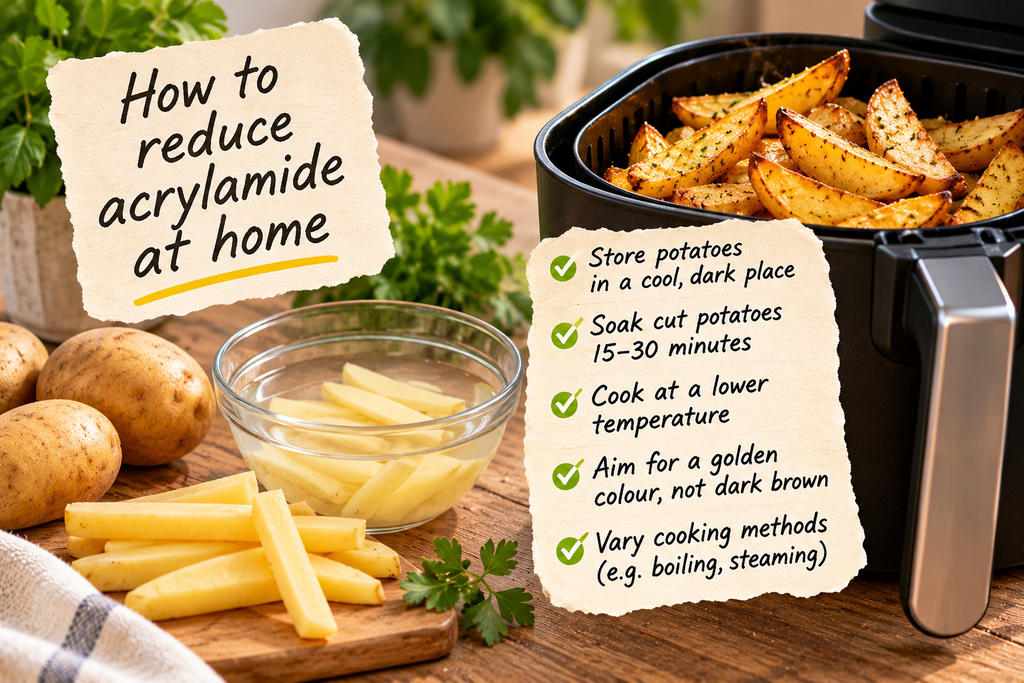
Fortunately, reducing unnecessary acrylamide formation doesn’t require expensive equipment, unusual ingredients or eliminating familiar foods. Some of the most useful changes involve storage, preparation and the degree of browning during cooking. Potatoes are particularly interesting because their sugar content, variety and storage conditions can strongly influence how much acrylamide forms when they are fried or roasted. The FDA recommends storing potatoes in a cool, dark place rather than in the refrigerator, because refrigeration can increase reducing sugars in some potatoes and encourage greater acrylamide formation during subsequent high-temperature cooking.
Soaking cut potatoes in water for approximately 15–30 minutes before frying or roasting may also help reduce formation, provided they are drained and dried appropriately before cooking. Choosing a golden-yellow finish rather than allowing potatoes to become deeply browned is another practical adjustment. The same principle applies to bread, where lightly golden toast generally contains less acrylamide than very dark toast. Colour is only an approximate guide, but it offers a simple way to influence the outcome without needing laboratory equipment in our kitchens.
Air fryers are worth mentioning because they are often presented as a healthier alternative to deep frying. Although they can use considerably less added oil, this doesn’t automatically mean the finished food contains less acrylamide, since the compound forms through heat-related reactions rather than from the amount of oil alone. Temperature, cooking time, the ingredients and the final degree of browning all influence the result. An air fryer can be a useful cooking tool, but it doesn’t make acrylamide formation disappear.
When baking biscuits, crackers and other cereal-based foods, acrylamide formation also depends on recipe composition, moisture, raising agents and baking conditions. Manufacturers may adjust ingredients and processing methods to reduce concentrations, which helps explain why similar-looking products can produce very different laboratory results. At home, avoiding unnecessary over-baking and excessive darkening is a sensible starting point, while still ensuring that food is properly cooked and safe to eat. Boiling and steaming generally produce little acrylamide, so varying our cooking methods can also help reduce overall exposure without giving up the textures and flavours we enjoy.
You may also come across claims that antioxidants, certain plant compounds or supplements can protect the body from acrylamide. Researchers have investigated some of these possibilities, including substances involved in glutathione metabolism, but there is currently no established supplement proven to neutralise dietary acrylamide or prevent its potential long-term effects in humans. A varied, nutritious diet supports normal metabolic and cellular processes, but it shouldn’t be presented as a way to erase chemical exposure. Reducing avoidable formation during food preparation remains a more evidence-based approach than relying on detox products afterwards.
A Final Thought
The more I learn about food chemistry, the more I appreciate how much happens between a raw ingredient and the finished food on our plates. Cooking creates flavour, changes texture, improves digestibility and often makes food safer to eat, but some of those transformations can also produce compounds we would prefer to minimise. Acrylamide is a good example of why food cannot always be divided neatly into healthy and unhealthy categories, because it can appear in homemade meals, whole-grain products, commercially produced snacks and everyday kitchen favourites. Its presence alone doesn’t tell us whether a particular serving will cause harm, but understanding its formation and potential biological effects gives us a reasonable basis for reducing unnecessary exposure.
For me, the most useful response is neither to ignore the scientific evidence nor to become frightened of every golden crust. It is to recognise what we know, understand where uncertainty remains and make practical adjustments when they genuinely make sense. I still want to enjoy freshly baked biscuits, good bread and crispy potatoes, and I don’t believe that enjoying food should require constant calculations or anxiety. I simply prefer to know a little more about what happens when we prepare it, because informed choices are often the simplest ones to live with.
Selective, not restrictive.
Sources and Further Reading
Food Safety Authorities and Regulatory Guidance
- EFSA – Acrylamide in Food
- EFSA – Scientific Opinion on Acrylamide in Food (2015)
- FDA – Survey Data on Acrylamide in Food
- FDA – Total Diet Study Acrylamide Results
- FDA – Acrylamide and Diet, Food Storage, and Food Preparation
- European Commission – Acrylamide in Food
- Commission Regulation (EU) 2017/2158
- National Institute of Environmental Health Sciences – Acrylamide
Scientific Research
- Haemoglobin Adducts of Acrylamide in Human Blood: Review (2022)
- Kinetics of Elimination of Urinary Metabolites of Acrylamide in Humans (2006)
- Dietary Acrylamide Exposure and Site-Specific Cancer: Meta-analysis (2022)
- Maternal Acrylamide Exposure and Fetal Growth: Meta-analysis (2022)
- Prenatal Acrylamide Exposure and Fetal Growth: Danish Study (2025)
- Dietary Acrylamide and Gastrointestinal Health: Review (2024)
- Acrylamide Exposure and Cardiovascular Risk: Review (2024)








[…] Acrylamide in Everyday Food: How Much Are We Really Exposed To? […]