From green coffee beans and roasting chemistry to acrylamide, mycotoxins, pesticides, heavy metals and what laboratory testing reveals.
There is something about coffee that makes it more than just a drink. The smell of freshly ground beans, the sound of the coffee machine in the morning, that first warm sip before the day properly begins. For many of us, it’s a familiar ritual, something we enjoy without giving much thought to what is actually in our cup.
But coffee is far more complicated than its aroma and caffeine content might suggest. It contains hundreds of naturally occurring compounds, many of which change during roasting. Alongside substances that have been studied for their potential health benefits, coffee may also contain unwanted compounds formed during processing or introduced through growing, drying and storage.
That made me curious. We hear plenty about antioxidants, caffeine and whether coffee is good or bad for us, but how much do we really know about the coffee we’re buying? What happens to the beans before they reach our kitchens? And are there companies that actually test their products and allow customers to see the results?
I decided to look beyond the packaging and explore what the chemistry and laboratory evidence can tell us.
From Green Beans to Roasted Coffee: What Really Changes?
Before coffee develops its familiar rich aroma, it starts as a green bean. Green coffee contains carbohydrates, proteins, fats, caffeine, chlorogenic acids, trigonelline and many other naturally occurring substances. The transformation begins during roasting, when temperatures commonly reach around 180–240°C and trigger a series of chemical reactions, including the Maillard reaction responsible for much of the browning and complex aroma associated with cooked foods.
Roasting changes far more than flavour. Some compounds break down, others are transformed, and entirely new substances appear. Understanding those changes helps explain why green and roasted coffee can have very different chemical profiles, even when they come from the same beans.
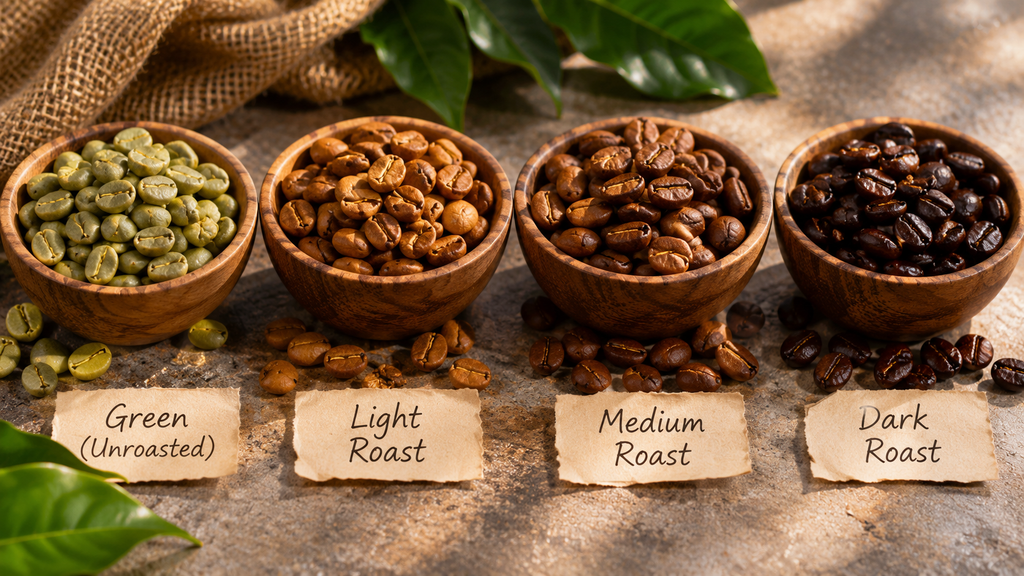
Green Coffee Beans vs Roasted Coffee Beans
| Compound | Green coffee beans | Roasted coffee beans |
|---|---|---|
| Caffeine | Naturally present | Relatively stable; concentration per gram may change |
| Chlorogenic acids | Generally abundant | Reduced or transformed, particularly with darker roasting |
| Trigonelline | Naturally present in relatively high amounts | Partly breaks down, contributing to aroma and niacin formation |
| Niacin (vitamin B3) | Present in smaller amounts | Some is formed from trigonelline during roasting |
| Melanoidins | Roasting-derived melanoidins largely absent | Form through Maillard reactions |
| Cafestol and kahweol | Naturally present in coffee oils | Remain present, although levels can change |
| Acrylamide | Generally absent or present at very low levels | Forms during roasting and may decrease as roasting continues |
| Ochratoxin A (OTA) | May be present following fungal contamination | Some may survive roasting |
| Pesticide residues | Depend on agricultural and environmental exposure | Some decrease during roasting; others may persist |
| Heavy metals | May be absorbed from soil or introduced through contamination | Not destroyed by roasting |
| Water content | Commonly around 8–12% | Usually reduced to approximately 1–5% |
| Aroma compounds | Relatively few characteristic roasted-coffee aromas | Hundreds of volatile aroma compounds develop |
These are general patterns rather than fixed concentrations. Coffee variety, growing conditions, processing and roast profile all influence the final composition.
One of the most interesting changes involves chlorogenic acids, a group of naturally occurring compounds studied for their antioxidant properties and possible metabolic effects. Green coffee generally contains more of them, while roasting reduces or transforms a substantial proportion. At the same time, new compounds such as melanoidins develop, and trigonelline contributes to the formation of niacin and aroma molecules.
This doesn’t mean green coffee is automatically healthier or roasted coffee is somehow inferior. Each has a different chemical composition, and a higher concentration of one potentially beneficial compound doesn’t tell us everything about its effects in the body.
The brewing method adds another layer. Cafestol and kahweol, two compounds found in coffee oils, are present in greater amounts in some unfiltered preparations. Cafestol can raise LDL cholesterol, while paper filters retain much of these oils. So even after roasting, the way we prepare coffee influences what eventually reaches our cup.
Acrylamide: A Chemical Created During Roasting
Acrylamide is one of the less desirable compounds formed during high-temperature food processing. It isn’t deliberately added to coffee. It develops through reactions involving naturally occurring components of the beans, particularly during the early stages of roasting.
Interestingly, darker coffee doesn’t necessarily contain more acrylamide. The compound forms as roasting progresses but can also break down with further heating, meaning lighter roasts may sometimes contain higher concentrations than medium or darker roasts. That doesn’t automatically make dark coffee healthier, because roasting changes many other compounds at the same time.
Acrylamide deserves attention because of its toxicological properties. Animal studies have shown that exposure can increase the likelihood of genetic mutations and tumours, with its metabolite glycidamide playing an important role. Evidence from human dietary studies remains limited and inconsistent, but the European Food Safety Authority (EFSA) considers acrylamide in food a potential public health concern.
How Much Acrylamide Has Been Found in Popular Coffee Brands?
The US Food and Drug Administration (FDA) published measurements of acrylamide in familiar coffee products during the early 2000s. Although these results are historical, they provide useful examples of how concentrations can vary between products and preparation stages.
| Coffee product | Sample tested | Acrylamide |
|---|---|---|
| Nescafé Classic Instant Coffee | Dry powder | 471 µg/kg |
| Folgers Classic Roast Instant Coffee | Dry powder | 458 µg/kg |
| Maxwell House Instant Naturally Decaffeinated | Dry powder | 172 µg/kg |
| Starbucks Breakfast Blend | Ground, unbrewed | 161 µg/kg |
| Starbucks Colombia | Ground, unbrewed | 163 µg/kg |
| Folgers Classic Roast | Ground, unbrewed; three lots | 350–374 µg/kg |
| Café Bustelo Dark Roast | Ground, unbrewed; three lots | 134–142 µg/kg |
Source: FDA, Survey Data on Acrylamide in Food. Historical measurements from the early 2000s, not current product testing or a ranking of today’s brands.
At first glance, a result of 471 µg/kg might sound substantial, but the figure refers to dry instant coffee rather than a prepared drink. A kilogram of dry coffee is very different from a mug containing mostly water, and comparing those numbers directly can create a misleading impression.
Fortunately, the FDA also analysed prepared coffee, allowing us to estimate how much acrylamide might be present in a typical serving.
How Much Acrylamide Is in One Cup?
| Coffee tested as a prepared drink | Acrylamide in the drink | Estimated amount in 250 ml |
|---|---|---|
| Nescafé Classic Instant | 6 µg/kg | 1.50 µg |
| Starbucks | 8 µg/kg | 2.00 µg |
| Dunkin’ Donuts | 8 µg/kg | 2.00 µg |
| Maxwell House Master Blend | 8 µg/kg | 2.00 µg |
| Folgers Classic Roast | 13 µg/kg | 3.25 µg |
| Café Bustelo Dark Roast | 6 µg/kg | 1.50 µg |
| Maxwell House Instant Decaf | 3 µg/kg | 0.75 µg |
Source: FDA. Concentrations were reported in µg/kg. The estimates assume that 250 ml of prepared coffee weighs approximately 250 g. Results apply to the historical samples and preparation methods tested.
These measurements put the dry-coffee figures into perspective. Many of the prepared samples contained approximately one to three micrograms of acrylamide per 250 ml serving. However, drinking several cups throughout the day means those small amounts contribute repeatedly to our overall exposure.
How Much Acrylamide Comes From Your Daily Coffee?
How Much Acrylamide Is in Your Daily Coffee?
Explore an estimate based on historical FDA measurements of prepared coffee. Adjust the settings to reflect your usual coffee routine.
How it’s calculated: cups × volume in litres × concentration in µg/kg, assuming 1 litre of prepared coffee weighs approximately 1 kg. Values are estimates based on specific historical FDA samples, not current product testing. Cup size and preparation can change actual concentrations; the calculation excludes other dietary sources of acrylamide and does not assess health risk.
Use the calculator to select the number of cups you drink, your usual serving size and one of the historical FDA measurements. It will estimate your daily acrylamide intake from coffee alone.
For example, three 250 ml mugs containing approximately 8 µg/L would provide around 6 µg of acrylamide per day.
The calculation is based on the amount of coffee consumed multiplied by the measured concentration. It is an educational estimate rather than a laboratory analysis of the coffee in your kitchen, and it cannot determine your personal cancer risk.
Is There a Safe Daily Amount of Acrylamide?
Unlike some food contaminants, acrylamide doesn’t have an established tolerable daily intake (TDI). Because acrylamide and glycidamide can damage genetic material, EFSA concluded that it couldn’t establish a daily exposure level considered tolerable for cancer-related effects.
Instead, EFSA uses an approach called the Margin of Exposure (MOE), comparing estimated human exposure with doses associated with adverse effects in toxicological studies. This helps scientists assess the level of concern, but it isn’t a personal safety allowance.
The European Union also establishes benchmark levels for acrylamide in certain food categories. These are intended to help manufacturers monitor and reduce acrylamide formation during production. They shouldn’t be confused with a permitted daily intake for consumers.
This distinction is important because food safety assessments consider population-level exposure, available toxicological evidence and uncertainty. They provide a valuable framework for reducing risk, but they cannot predict exactly how any individual will respond to a particular exposure.
Coffee Isn’t Our Only Source of Acrylamide
Coffee may be an important contributor to dietary acrylamide exposure in adults, but it’s far from the only one. Acrylamide also forms when certain carbohydrate-rich foods are cooked at high temperatures, particularly through frying, roasting and baking.
| Food | How acrylamide forms |
|---|---|
| Coffee | During roasting |
| Potato crisps | During high-temperature frying |
| Chips and roasted potatoes | During frying or roasting |
| Toast | As bread browns |
| Biscuits and crackers | During baking |
| Breakfast cereals | During some high-temperature processing methods |
| Crispbreads and baked snacks | During baking and browning |
The amount can vary considerably, even within the same food category. A lightly toasted slice of bread won’t necessarily contain the same concentration as a very dark one, and the temperature, cooking time and ingredients all influence the result.
Think about an ordinary day. We might drink coffee with breakfast, eat toast, have roasted potatoes later and enjoy a few biscuits in the afternoon. Each food may contribute a different amount, and these exposures can be repeated over many years.
That doesn’t mean we need to avoid ordinary foods or become anxious about every browned surface. Simple cooking choices, such as avoiding excessive browning and varying cooking methods, can help reduce exposure without turning everyday eating into a list of restrictions.
If you’re curious about how much acrylamide we actually consume from everyday foods, what laboratory testing reveals and what happens to it inside our bodies, I’ve explored these questions in more detail in Acrylamide in Everyday Food: How Much Are We Really Exposed To?.
What Happens to Acrylamide Inside the Body?
After consumption, acrylamide is absorbed through the digestive tract and distributed throughout the body. Some is processed through pathways involving glutathione, while a portion is converted by enzymes, including CYP2E1, into glycidamide. Glycidamide is particularly relevant because it can react with DNA and is considered an important contributor to the effects observed in animal studies.
Acrylamide and its metabolites are eliminated primarily through urine. Unlike certain heavy metals, such as cadmium, acrylamide isn’t generally considered a substance that accumulates in body tissues over decades. Nevertheless, repeated exposure may still matter because biological effects can occur while a substance is being metabolised, even if it is subsequently removed.
Our bodies don’t all handle chemicals identically. Age, genetics, smoking, liver and kidney function, nutritional status and other aspects of health can influence metabolic processes. However, the precise contribution of these factors to an individual’s cancer risk from dietary acrylamide isn’t well established, and it would be misleading to suggest that we can calculate that risk simply by knowing someone’s age or lifestyle.
Good nutrition supports normal metabolic and cellular repair processes, but it cannot be assumed to neutralise the effects of acrylamide. The more useful approach is to understand exposure in the context of our overall diet and health, rather than searching for a single ingredient or supplement that promises protection.
Mycotoxins: What Can Happen Before Roasting?
Coffee begins as an agricultural crop, and conditions during harvesting, drying, transport and storage can influence its quality long before it reaches a roaster. If beans are exposed to unsuitable moisture or storage conditions, certain fungi may develop and produce compounds known as mycotoxins.
One of the most widely investigated mycotoxins in coffee is ochratoxin A (OTA). It is associated with toxic effects, particularly involving the kidneys, and its presence is monitored in food safety programmes. Some coffee testing programmes also examine aflatoxins and other fungal toxins.
A 2024 systematic review examining 3,256 coffee samples from published studies reported ochratoxin A in 1,778 samples, approximately 54.6%. That may sound alarming, but detection doesn’t automatically mean a product exceeded a regulatory limit or posed a significant risk. The review generally reported low estimated dietary exposures, although findings varied between studies.
Roasting can reduce viable mould and some mycotoxin concentrations, but the two are not interchangeable. Killing a fungus doesn’t necessarily destroy the toxin it may already have produced. This is why appropriate drying and storage remain important, and why a laboratory test for mould isn’t the same as a test for mycotoxins.
Pesticides: What Might Remain After Roasting?
Coffee farming can involve herbicides, insecticides and fungicides, depending on agricultural practices and local conditions. Residues may sometimes remain in harvested beans, although their concentrations depend on the chemicals used, environmental conditions and subsequent processing.
Glyphosate is one familiar example, but it’s only one substance among many. Its degradation product, AMPA, can also be relevant, and a test for glyphosate alone doesn’t automatically include AMPA unless the laboratory specifically analyses it.
Roasting may reduce some pesticide residues, but different compounds respond differently to heat. It’s therefore inaccurate to assume that roasting eliminates every agricultural chemical.
Organic certification can provide useful information about farming standards and restrictions on certain inputs, but it isn’t a laboratory guarantee that every possible contaminant is absent. For consumers who want more detail, product-specific testing offers an additional source of information.
Heavy Metals: What Can Coffee Absorb From Its Environment?
Coffee plants take up elements from soil and water as they grow. Some are essential nutrients, while others, including lead, cadmium, arsenic and mercury, may raise health concerns depending on their concentrations, chemical forms and the amount consumed.
Their presence may reflect natural geological conditions, environmental pollution or contamination introduced during production. Roasting doesn’t destroy metals, although changes in moisture and bean mass can affect the concentrations reported per kilogram.
An important distinction is that the concentration measured in dry coffee doesn’t necessarily represent what ends up in a prepared drink. Different elements can transfer into water at different rates, depending on the brewing method and chemical conditions.
Some metals also behave differently inside the body. Cadmium, for example, can accumulate over long periods, particularly in the kidneys, whereas other substances have different distribution and elimination patterns. Understanding those differences is more useful than treating every detectable metal as though it carries the same risk.
Which Coffee Brands Publish Independent Laboratory Testing?
After exploring what coffee can contain, I became particularly interested in what manufacturers are willing to share about their products.
Some companies commission independent laboratories to examine coffee for mycotoxins, pesticide residues, heavy metals or compounds formed during roasting. Others provide broader quality assurances without making detailed certificates easily accessible.
Neither approach automatically proves that one coffee is safer than another. But a laboratory report can give consumers something more useful than a marketing claim: information about the sample tested, the substances analysed and the actual findings.
The brands below are included as examples of published testing information, not as product recommendations. This article is not sponsored, and I have no affiliation with any of these companies.
Six Coffee Brands Sharing Testing Information
| Coffee brand | Published testing information | What the evidence covers |
|---|---|---|
| Purity Coffee | Historical testing programme covering contaminants and natural coffee compounds | Green and roasted samples, including comparative measurements |
| Natural Force Clean Coffee | Information about third-party contaminant testing | Selected coffee products and testing categories |
| Lifeboost Coffee | Third-party testing information | Selected coffees and contaminants |
| Danger Coffee | Lot-specific laboratory results | Green beans, roasted coffee and selected brewed-coffee testing |
| Biodynamic Coffee | Harvest-specific certificates of analysis | Mycotoxins, heavy metals and microbiological testing |
| Latin Bird Coffee | Independent analysis of a specified roasted-coffee lot | Heavy metals and mycotoxins |
These programmes differ in scope, and that’s worth understanding before comparing results. A test of green beans isn’t equivalent to one of roasted coffee, while a measurement in dry grounds doesn’t tell us exactly what reaches the finished drink.
Purity Coffee: A Broader Historical Testing Programme
Purity Coffee has published a historical programme that included testing across different coffee samples and production stages. Its published data cover mould and yeast, ochratoxin A, aflatoxins, pesticides, metals, acrylamide and naturally occurring compounds such as chlorogenic acids and trigonelline.
The programme provides an interesting comparison between green and roasted samples. In its dataset, mould or yeast was recorded as a problem in 19 of 23 green-coffee samples, compared with 4 of 63 roasted samples. These weren’t matched before-and-after samples of the same beans, so the figures shouldn’t be interpreted as a precise measure of how much roasting reduced contamination.
Purity also published the following historical results for its roasted coffee.
| Substance or measurement | Published result | Sample |
|---|---|---|
| Acrylamide | 196 µg/kg | Roasted, dry coffee |
| Ochratoxin A | Below 0.2 µg/kg | Roasted coffee |
| Lead | 0.03 mg/kg | Roasted coffee |
| Cadmium | 0.002 mg/kg | Roasted coffee |
| Chlorogenic acids | 2.1 g/100 g | Roasted coffee |
| Trigonelline | 1.16 g/100 g | Roasted coffee |
Source: Purity Coffee, Independent Laboratory Tests. Historical programme results rather than current batch-specific measurements.
These findings are useful because they illustrate how a testing programme can examine both unwanted contaminants and naturally occurring coffee compounds. They don’t, however, establish the composition of every batch the company sells.
Danger Coffee: Why Individual Lots Matter
Danger Coffee publishes laboratory information linked to identified lots, including pesticide, mycotoxin and heavy-metal testing. Some of its reported glyphosate results are particularly interesting because they show that different green-coffee lots can produce different findings.
| Coffee lot | Sample stage | Substance | Reported result |
|---|---|---|---|
| MEX-P14443-2, September 2026 | Green beans | Glyphosate | <0.010 mg/kg |
| GAB-P03-2025, March 2026 | Green beans | Glyphosate | 0.012 mg/kg |
| MXAP03-1-2026, March 2026 | Green beans | Glyphosate | 0.016 mg/kg |
| GAB-P02-2025, March 2026 | Green beans | Glyphosate | 0.021 mg/kg |
| GAB-P01-2025, March 2026 | Green beans | Glyphosate | 0.022 mg/kg |
| GAB-P03-2025, March 2026 | Green beans | Ochratoxin A | <1.00 µg/kg |
Source: Danger Coffee, published lot-specific laboratory results. These are company-published results from independent laboratory testing, not samples independently purchased by a consumer organisation.
Some of these lots had measurable glyphosate residues, while another was reported below the laboratory’s stated detection threshold. The measured values alone don’t establish that the coffee was unsafe, and they shouldn’t be treated as evidence of what was present in the finished brewed drink.
What makes these reports informative is the ability to distinguish individual lots rather than relying on a blanket claim about an entire brand.
Biodynamic Coffee: When a Report Contains a Measurable Result
Biodynamic Coffee publishes certificates organised by harvest, including mycotoxin, heavy-metal and microbiological testing. One example is its June 2026 report for 18 Conejo Honduras, lot 013-0187-00006.
| Substance | Published result | Unit |
|---|---|---|
| Cadmium | 0.014 | mg/kg |
| Ochratoxin A | <0.003 | mg/kg |
| Deoxynivalenol (DON) | 0.38 | mg/kg |
| Zearalenone | 0.06 | mg/kg |
| Aflatoxin B1 | <1 | µg/kg |
Source: Biodynamic Coffee, Third-Party Lab Results, June 2026 harvest. Results refer to the identified green-coffee lot.
This is a useful reminder that laboratory testing isn’t always a story of everything being reported as undetectable. Some substances may be quantified while others fall below the reporting limits. The important questions are what was measured, in which sample, and how those findings should be interpreted in the context of exposure and applicable standards.
Latin Bird Coffee: Testing a Specific Roasted Lot
Latin Bird Coffee publishes an independent FoodChain ID analysis for roasted coffee lot #12983284, with a report issued in July 2025.
| Substance | Published result | Sample |
|---|---|---|
| Arsenic | <0.010 mg/kg | Roasted coffee |
| Cadmium | <0.010 mg/kg | Roasted coffee |
| Mercury | <0.010 mg/kg | Roasted coffee |
| Lead | <0.010 mg/kg | Roasted coffee |
| Ochratoxin A | Not detected within method limits | Roasted coffee |
| Listed other mycotoxins | Not detected within method limits | Roasted coffee |
Source: Latin Bird Coffee, Clean Coffee: Independent Lab Results. Findings apply to the tested lot and the substances included in the report.
The distinction between these results and those from Danger Coffee or Biodynamic Coffee is important. Latin Bird’s published analysis concerns a roasted sample, while the examples above include green-coffee lots. They cannot be used as a straightforward ranking of which brand contains the least contamination.
Natural Force and Lifeboost: Testing Information Without a Direct Numerical Comparison
Natural Force Clean Coffee and Lifeboost Coffee also provide information about third-party testing. Their published materials describe testing for selected contaminants, but the information available for comparison isn’t necessarily organised in the same way as the detailed lot-specific reports above.
Rather than placing unmatched measurements into a table, I think it’s more useful to recognise the difference between a general statement that testing is performed and a certificate identifying the exact product, sample date, analytical method and numerical result.
For anyone considering a particular coffee, the most relevant question is whether a report is available for the product and batch they intend to purchase.
How to Read Coffee Laboratory Results
Laboratory reports often contain abbreviations such as ND, LOD and LOQ. These terms may look technical, but understanding them makes a considerable difference when interpreting marketing claims.
| Laboratory term | What it means |
|---|---|
| ND | Not detected under the conditions of the test |
| LOD | Limit of detection: the lowest concentration distinguishable from background by the method |
| LOQ | Limit of quantification: the lowest concentration the method can measure with acceptable reliability |
| <0.010 mg/kg | Below the stated threshold; not proof of absolute zero |
| 0.014 mg/kg | A quantified concentration, subject to the method’s measurement characteristics |
A report stating that a substance wasn’t detected doesn’t necessarily prove that none was present. It means the laboratory didn’t identify it above the relevant analytical threshold. The list of substances included in the test matters too: a pesticide screen covering hundreds of compounds doesn’t necessarily include every possible contaminant or metabolite.
It’s also worth distinguishing between independent laboratory analysis and independent sample selection. A company may send its own chosen sample to an external laboratory, while a consumer organisation may purchase a product anonymously from a retailer. Both approaches can provide useful evidence, but they answer slightly different questions.
What About Other Familiar Coffee Brands?
Not all published coffee testing comes from manufacturers. Food safety authorities and consumer organisations also examine retail products, sometimes independently of the companies producing them.
The Slovenian Consumers’ Association, ZPS, tested Costa Coffee Espresso capsules in November 2023 and published the following results.
| Product | Substance | Published result |
|---|---|---|
| Costa Coffee Espresso capsules | Acrylamide | 140 µg/kg |
| Costa Coffee Espresso capsules | Ochratoxin A | 0 µg/kg |
Source: ZPS, Costa Coffee Espresso consumer test, 30 November 2023. These results concern the coffee in the tested capsules, not a prepared espresso.
The ochratoxin A result was displayed as zero, but the public summary doesn’t specify the analytical detection limit behind that figure. It would therefore be inaccurate to interpret it as proof of absolute absence.
This example also illustrates why product stage matters. A concentration reported for coffee inside a capsule isn’t the same as the amount extracted into a prepared drink. Nor can one test establish the composition of every batch sold under the same brand.
The historical FDA measurements for Nescafé, Starbucks, Folgers, Maxwell House, Dunkin’ Donuts and Café Bustelo should be understood in exactly the same way: useful examples from identified testing programmes, not permanent judgements about the brands.
Does Organic or Premium Coffee Mean Cleaner Coffee?
It’s tempting to assume that a more expensive coffee must be better in every possible way. But organic certification, speciality grading, premium pricing and laboratory testing tell us different things.
Organic certification relates to farming and production standards, while speciality grading focuses heavily on bean quality and flavour. A higher price may reflect origin, labour, small-scale production, scarcity or branding. None of these automatically guarantees the absence of mycotoxins, pesticide residues, heavy metals or acrylamide.
That doesn’t make these labels meaningless. They can tell us something valuable about how a coffee was produced. I simply prefer not to confuse production standards or attractive packaging with a chemical analysis.
When choosing coffee, I want to know where the beans come from, whether the company explains its processing and storage practices, and whether laboratory results are available. If a product is marketed as particularly clean, I think it’s reasonable to ask what that claim actually means and which substances were tested.
A detailed certificate isn’t a promise that every future batch will be identical, but it does provide a clearer basis for understanding the product than a general claim of purity.
A Final Thought
I still enjoy the simple pleasure of coffee. Learning about its chemistry hasn’t made me want to turn an everyday ritual into something complicated or frightening. But it has made me more curious about the products we consume so regularly and how much information is available about them.
Food safety standards, scientific research and laboratory testing all have an important place in helping us understand exposure. At the same time, no single test or regulatory threshold can describe every aspect of a person’s health, dietary habits or long-term contact with different substances. Our bodies are constantly absorbing, transforming and eliminating compounds, and those processes are influenced by many factors. The presence of a detectable substance doesn’t automatically mean harm, just as a reassuring label doesn’t answer every possible question.
For me, the point of understanding what’s in our food and drinks isn’t to create fear or tell people what they should consume. It’s about having enough information to make our own decisions, appreciating the complexity of what we eat and drink, and remembering that we can enjoy something while still being curious about it.
Coffee can remain a comforting daily ritual. We can simply know a little more about what’s in the cup.
Selective, not restrictive.
Sources and Further Reading
Scientific Research and Food Safety
- FDA – Survey Data on Acrylamide in Food
- EFSA – Acrylamide in Food
- EFSA – What Happens to Acrylamide in the Body?
- EFSA – Margin of Exposure
- 2024 Systematic Review – Ochratoxin A in Coffee
- ZPS – Costa Coffee Espresso Consumer Test
Coffee Laboratory Testing