

Have you ever turned a packet of beef gravy granules around and actually read the ingredients? Not just the cooking instructions or nutritional information, but what really goes into that familiar brown sauce. I did, and something caught my attention. The product was supposed to taste like beef gravy, yet I couldn’t find any beef or beef stock on the ingredient list.
Of course, not all gravy granules are made the same way. Some contain real beef, beef extract or stock, while others rely on a carefully formulated mixture of starches, fats, seasonings and flavourings. It was this particular product that made me curious, especially when I realised that its main ingredients were potato starch, palm oil and salt.
But one word interested me more than anything else: flavourings. A single word that can represent a complex combination of substances responsible for creating a familiar taste, without telling us exactly what those substances are. It made me wonder how much we really know about the flavours we consume every day.
And that’s where my curiosity began. How do starch, fat, salt and flavourings become beef gravy? What exactly happens during food manufacturing to create that familiar meaty taste? And beyond flavour, what do these ingredients contribute to our diet, how might they affect our bodies, and who should pay closer attention?
Potato Starch: The Ingredient That Creates Thickness
Potato starch is often one of the main ingredients in instant gravy granules. When mixed with hot water, its starch granules absorb water and swell, creating the thick, smooth consistency we expect from gravy. It’s also something I use myself when thickening homemade sauces.
Potato starch is primarily carbohydrate, and cooking makes much of its starch readily digestible. For someone managing blood glucose, the amount consumed and the rest of the meal matter more than the ingredient’s presence alone. A small portion of gravy may provide relatively little carbohydrate, but generous amounts alongside several other starchy foods can change the overall picture.
There’s also an interesting difference between ordinary potato starch used as a thickener and resistant starch, which can reach the large intestine and be fermented by gut bacteria. Heating starch in water changes its structure, so we shouldn’t assume that hot, freshly prepared gravy provides the same potential benefits as resistant starch.
Palm Oil: Texture, Saturated Fat and the Bigger Picture
Palm oil helps give instant gravy a smooth, rich mouthfeel and works well in dry products because of its physical properties. Unlike homemade gravy, where fat may come naturally from the meat and cooking juices, this fat is deliberately added as part of the formulation.
Palm oil contains a substantial proportion of saturated fatty acids, particularly palmitic acid. When saturated fats replace unsaturated fats in the diet, LDL cholesterol can rise in many people. This matters especially for someone with elevated LDL cholesterol or increased cardiovascular risk, although the amount of palm oil in an individual serving of gravy may be small.
Another consideration is how refined oils are processed. High-temperature refining can generate contaminants such as glycidyl fatty acid esters and 3-MCPD esters, which have been assessed by food safety authorities because of their potential toxicological effects. The presence and quantity of these contaminants depend on the oil and manufacturing process, and an ingredient list doesn’t reveal their levels.
Palm Oil Refining: What Are 3-MCPD and Glycidyl Esters?
Palm oil raises an interesting question that goes beyond its saturated-fat content. During high-temperature refining, particularly deodorisation, certain unwanted compounds can form. Two groups that have attracted attention from food safety researchers are 3-MCPD fatty acid esters and glycidyl fatty acid esters.
These compounds are not intentionally added to foods. They are processing contaminants that can develop when oils are refined under particular conditions. Although they can occur in different refined vegetable oils, historically elevated concentrations have been reported in some refined palm oils. Manufacturing improvements can reduce their formation, but the ingredient list on a packet of gravy won’t tell us how much, if any, is present in the finished product.
Why are scientists interested in them? Studies in experimental animals have linked exposure to 3-MCPD with kidney toxicity, while glycidol, which can be released from glycidyl esters during digestion, is considered genotoxic and carcinogenic based on toxicological evidence. This is why food safety authorities have established risk assessments and regulatory measures aimed at limiting exposure.
Children deserve special consideration because their body weight is lower and their dietary exposure to certain contaminants can be proportionally higher. People who regularly consume multiple foods containing refined fats may also have different exposure patterns from those who eat such products occasionally. However, the actual risk depends on measured contaminant concentrations and total dietary intake, not simply on whether palm oil appears in the ingredients.
What I find important here is that refining can change more than the appearance, flavour and stability of an oil. It can also introduce substances that weren’t present in the same amounts in the original raw material. Understanding that process helps us ask better questions about food manufacturing and long-term dietary exposure.
Salt: One of the Clearest Reasons to Read the Label
Salt might be the most familiar ingredient on the list, but it’s also one of the most important. In one supermarket beef gravy, a prepared 75 ml serving contains approximately 0.59 g of salt. That is already close to 12% of the World Health Organization’s recommended daily maximum of 5 g for adults.
A single serving isn’t the whole story. Think about a meal that includes salted meat, seasoned potatoes, gravy and perhaps another prepared side dish. The salt from each component adds up, often without us noticing. People with high blood pressure, cardiovascular disease or certain kidney conditions may need to pay particular attention to their overall sodium intake.
Excess sodium intake is associated with increased blood pressure and cardiovascular risk, and this relationship is supported by substantial human research. It’s a useful reminder that familiar ingredients can have meaningful effects when consumed in excessive amounts over time.
Wheat Flour and Barley Malt Extract: Important for Sensitive Digestion
Wheat flour contributes to the body and texture of some gravy granules, while barley malt extract adds flavour, colour and a subtle malty sweetness. Both ingredients are worth checking carefully because they come from gluten-containing cereals.
For someone with coeliac disease, gluten exposure can trigger an immune reaction that damages the lining of the small intestine. Symptoms may include bloating, diarrhoea, constipation, fatigue or abdominal discomfort, although some people have few obvious digestive symptoms. Wheat allergy is a different condition and can cause reactions ranging from skin symptoms to serious allergic responses.
Barley malt extract deserves particular attention because its gluten content can vary depending on processing and the amount used. A product containing barley malt extract should not automatically be considered suitable for someone with coeliac disease unless it is appropriately labelled gluten-free or its suitability has been confirmed.
For people with irritable bowel syndrome, wheat-based ingredients may also contribute to symptoms in some circumstances, particularly because wheat contains fermentable carbohydrates called fructans. However, a small amount of flour in gravy won’t necessarily cause the same response as a large portion of bread or pasta. Individual tolerance and serving size matter.
Maltodextrin: More Than Just a Bulking Ingredient?
Maltodextrin is a carbohydrate produced by breaking down starch, often from maize, potatoes, rice or wheat. Manufacturers use it for several reasons, including adding bulk, improving texture and helping flavouring ingredients distribute evenly throughout a dry mixture.
It’s generally rapidly digested and can produce a high glycaemic response when consumed in meaningful quantities. This is relevant for people managing diabetes, insulin resistance or blood glucose fluctuations. However, the amount in a small serving of gravy is likely to be considerably less than in products where maltodextrin is a major carbohydrate source.
Maltodextrin has also attracted scientific interest because laboratory and animal studies have explored its effects on gut bacteria, intestinal mucus and interactions between microbes and the gut lining. Certain experiments have reported changes that raise questions about intestinal health, but those findings cannot simply be translated into a claim that normal dietary exposure causes inflammatory bowel disease in humans.
Maltodextrin and the Gut Microbiome: What Does Human Research Tell Us?
One reason maltodextrin interests me is that it appears in so many different products. From gravy granules and seasoning mixes to sauces, protein powders and processed snacks, it’s easy to consume this ingredient from several sources without giving it much thought. And while we know quite a lot about how maltodextrin is digested as a carbohydrate, questions about its interactions with the gut microbiome are more complicated.
Some laboratory and animal studies have reported changes in bacterial behaviour, intestinal mucus and the interaction between microbes and the gut lining following exposure to certain maltodextrins. Researchers have also investigated whether maltodextrin can influence the behaviour of bacteria associated with inflammatory bowel conditions. These findings are interesting because the gut microbiome is involved in much more than digestion, including immune signalling and the production of metabolites that interact with our intestinal cells.
But what about humans? Clinical evidence remains limited and difficult to interpret. Maltodextrin has frequently been used as a placebo or control ingredient in nutrition studies, meaning it wasn’t always the substance researchers were specifically investigating. Some studies have measured microbiome changes, but differences in dosage, study duration, participant health and the types of maltodextrin used make it difficult to draw a consistent conclusion about long-term harm.
There’s also an important distinction between ordinary maltodextrin and resistant maltodextrin, sometimes called resistant dextrin. These ingredients are not metabolically identical. Resistant maltodextrin is designed to resist digestion in the small intestine and can act as a fermentable dietary fibre, whereas conventional maltodextrin is generally digested and absorbed much more readily. Research findings about one should not automatically be applied to the other.
For people with inflammatory bowel disease, persistent digestive symptoms or other gastrointestinal conditions, the question deserves particular attention, although current evidence doesn’t establish that ordinary dietary maltodextrin causes or worsens these diseases. What interests me most is the broader question of repeated exposure. When the same ingredient appears in numerous foods throughout the day, how might that pattern interact with an individual’s existing microbiome, diet and intestinal health? It’s a question worth investigating rather than dismissing simply because we don’t yet have a definitive answer.
Hydrolysed Maize Protein: Where the Savoury Flavour Comes From
Hydrolysed maize protein is one of the most interesting ingredients in beef-flavoured gravy. It is made by breaking down maize proteins into smaller peptides and amino acids, which can contribute a savoury, broth-like taste. This process helps manufacturers create flavour without relying entirely on meat-derived ingredients.
Some of the resulting amino acids, including glutamate, contribute to umami, the savoury taste we associate with meat stock, mushrooms, tomatoes and aged cheese. Glutamate also occurs naturally in many foods, so its presence is not unique to processed products.
There have been reports of symptoms such as headaches, flushing or discomfort following consumption of certain savoury flavour enhancers, particularly monosodium glutamate. However, controlled human studies have not consistently demonstrated these reactions at ordinary dietary exposures, and hydrolysed maize protein should not automatically be treated as equivalent to a particular dose of added MSG.
For someone who repeatedly experiences symptoms after eating specific products, the complete ingredient list and the circumstances of the reaction deserve attention. The cause could involve several factors, including other ingredients, salt, portion size or an unrelated condition. Identifying a genuine sensitivity requires more than assuming that one unfamiliar ingredient is responsible.
Flavourings: The Ingredient That Tells Us the Least
When I read flavourings on a food label, my first question is always the same: which flavourings? This broad term can cover different substances used to create or enhance a particular taste or aroma, and the full formulation usually isn’t disclosed to consumers.
That makes it difficult to know precisely which compounds are responsible for the final flavour. It also means we cannot determine their potential effects from the word flavourings alone. Different substances have different properties, and any meaningful safety assessment needs to consider the specific compounds, their doses and the available toxicological evidence.
For people with food allergies or strict dietary requirements, the source of flavourings can be important. Allergenic ingredients that fall under mandatory labelling rules must be declared, but the general term doesn’t necessarily answer every question about animal origin, manufacturing methods or personal sensitivities.
This is one reason I prefer transparency in food labelling. I don’t expect every manufacturer to publish a complete flavour formula on the front of a packet, but I do believe consumers benefit from knowing more about what creates the taste of their food.
Soya Lecithins: What Do Emulsifiers Actually Do?
Lecithins are emulsifiers that help ingredients mix and remain evenly distributed. In instant gravy, they support the texture and help fat interact with the other components when water is added. Soya lecithins are derived from soybeans and consist largely of phospholipids.
Emulsifiers have become an important topic in research into processed foods and the gut microbiome. Some experimental studies have found that particular emulsifiers, notably carboxymethylcellulose and polysorbate 80, can affect intestinal mucus, microbial communities or inflammatory processes under certain conditions.
But different emulsifiers are chemically different substances. Findings involving carboxymethylcellulose or polysorbate 80 cannot automatically be applied to soya lecithins. The evidence for harmful gut effects from ordinary dietary amounts of lecithins is much less established, and this distinction matters when interpreting research.
People with soy allergy should check the product’s allergen information carefully, although highly refined soy-derived ingredients may contain very little residual protein. The exact product and its labelling remain important.
Can These Ingredients Irritate the Gut?
This is a question I find particularly interesting because digestion is not simply about whether a food contains something labelled as an additive. Our digestive response depends on the amount eaten, the rest of the meal, our microbiota, underlying conditions and individual sensitivity.
For someone with coeliac disease, gluten-containing gravy may provoke a well-established immune response. For someone with wheat allergy, the concern is an allergic reaction. People with IBS may experience bloating or discomfort from certain ingredients, although the small quantities present in gravy don’t necessarily produce symptoms.
Research into some food additives and intestinal health is developing, particularly in relation to the microbiome and gut barrier. But we need to distinguish between evidence from human clinical trials, observational research, animal studies and laboratory experiments. They answer different questions, and none should be presented as more conclusive than it is.
I also think it’s worth considering the whole diet. Someone might eat gravy granules occasionally with a Sunday roast, while another person regularly consumes ready-made sauces, stock cubes, flavoured snacks, processed meats and convenience meals. Those patterns create very different exposures to sodium, saturated fats and various food-processing ingredients.
The Question of Cumulative Exposure
One of the limitations of looking at a single ingredient in a single product is that it doesn’t necessarily reflect how people actually eat. We rarely consume food additives one at a time in isolation. We eat combinations of foods, sometimes several times a day, over many years.
Food safety assessments do consider estimated dietary exposure, and in some cases combined exposure to related substances. Yet important scientific questions remain about certain mixtures, long-term dietary patterns, microbiome responses and differences between individuals. These are active areas of research rather than questions that can be answered with a simple yes or no.
This doesn’t mean that every combination of additives produces a harmful effect. It means that the totality of our diet matters. A small serving of gravy is one part of a much bigger picture, and understanding that picture is more useful than judging health by a single ingredient.
For me, this is also where cooking from scratch becomes valuable. It gives me more control over the ingredients, the amount of salt and fat, and the way flavour is created. I don’t have to wonder what gives my homemade gravy its beef flavour, because I know exactly where it came from.
Who Should Pay Particular Attention to Beef Gravy Granules?
There are several groups of people for whom reading the ingredient list may be especially useful. People with coeliac disease or wheat allergy need to check for wheat, barley and relevant allergen declarations. Those with soy allergy should pay attention to products containing soya lecithins or soy-derived flavourings.
People managing high blood pressure, cardiovascular disease or kidney conditions may need to consider sodium intake, while those with elevated LDL cholesterol may want to look at their overall saturated-fat consumption. Anyone managing blood glucose should consider the carbohydrate content and serving size rather than assuming a savoury sauce has no effect.
For people with ongoing digestive symptoms, the situation is more individual. A food diary may help identify patterns, but recurring or significant symptoms deserve proper medical assessment rather than prolonged self-imposed restrictions. The goal is to understand what is happening in the body, not to remove more and more foods without knowing why.
What About Premium Beef Gravy Granules?
You might expect a more expensive beef gravy to contain considerably more beef, but that isn’t always the case. One premium supermarket version I examined listed beef at just 1% of the dry product, alongside red onion, starch, palm oil, salt, flavourings and hydrolysed maize protein.
The presence of real beef makes it different from a product with no declared beef ingredient, but the percentage still tells an interesting story. Premium packaging and a higher price don’t necessarily mean the product is based primarily on meat juices or traditional stock.
This is why I find ingredient percentages so useful. They help us understand what a product is actually made from, rather than relying entirely on its name, appearance or marketing.
Homemade Gravy: Knowing Where the Flavour Comes From
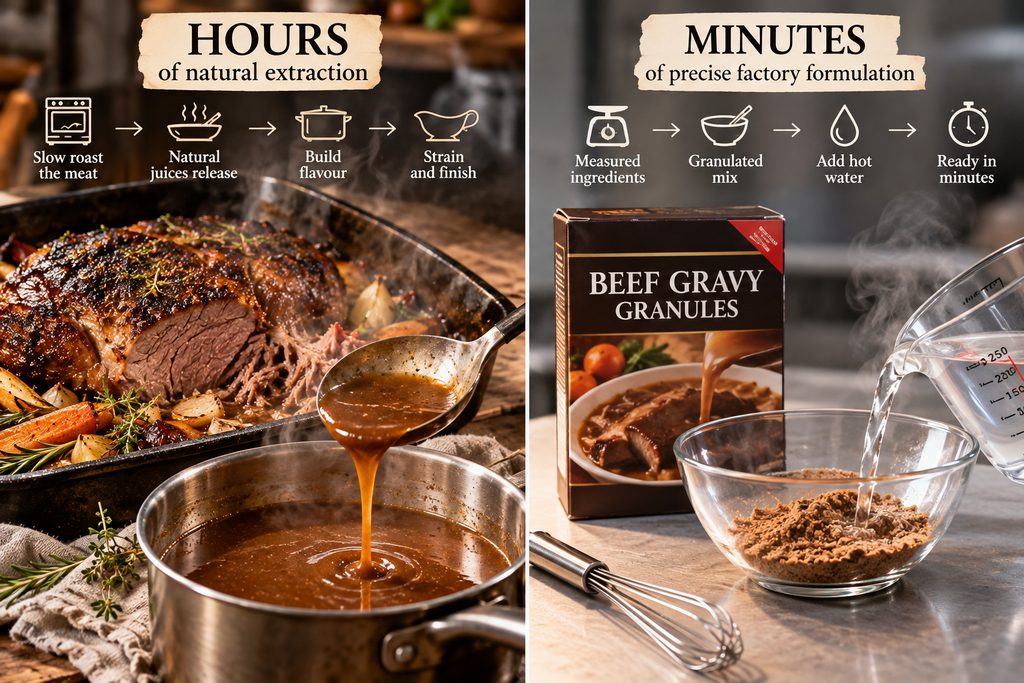
When I prepare slow-roasted beef shoulder, the gravy starts developing while the meat is still in the oven. The beef slowly cooks with onion, garlic, honey, balsamic vinegar and water, releasing its juices into the cooking liquid. By the time the meat is tender, I already have a flavourful base for my sauce.
I simply thicken the cooking juices with a little potato starch or cornflour mixed with cold water, add a splash of cream if I want a softer flavour, and adjust the seasoning. There’s no complicated technique involved, and I don’t need a packet of granules to recreate the taste of the beef I’ve just cooked.
The difference isn’t that homemade gravy contains no starch or fat. It can contain both. The difference is that the flavour comes from the actual ingredients I’ve cooked, and I can decide how much salt, cream or thickener to use.
That’s also why I find the taste so different. Personally, ready-made gravy often has a distinctive processed flavour that can overpower a beautiful roast. Homemade gravy tastes like the food it came from, and for me, that makes the extra few minutes worthwhile.
Food Labels Are About Awareness, Not Restriction
My curiosity about beef gravy granules started with a simple question: where is the beef? But reading that label led me to think about much more than one product. It made me consider how flavours are created, how ingredients function, what we know about their effects and what scientists are still investigating.
I believe understanding food should empower us. We don’t need to be afraid of every unfamiliar ingredient, but neither do we need to accept every formulation without asking questions. There is room for curiosity, critical thinking and informed choices, even when the evidence is still developing.
Sometimes convenience is useful. Sometimes a homemade alternative is worth the time. And sometimes simply turning a packet around and reading the ingredients can change the way we look at the food we’ve been buying for years.
For me, that is what conscious eating is all about. Understanding what goes into our bodies, recognising our individual needs and making choices that support our health and quality of life.
Always Selective, Never Restrictive.






[…] How Do Starch, Fat, Salt and Flavourings Become Beef Gravy? […]