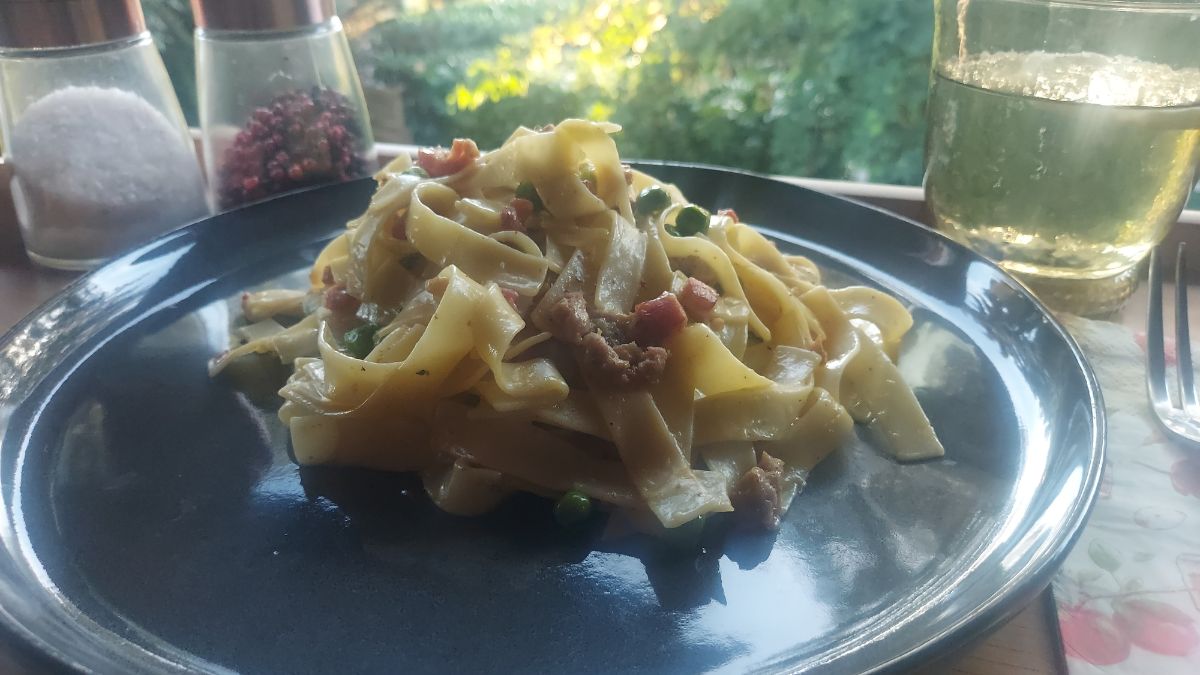
This 20 minute carbonara is probably my favourite dinner for days when I don’t have much time or simply don’t feel like cooking. I still want something homemade, I just don’t necessarily want to spend an hour in the kitchen making it.
That’s important to me. Even on those days, I know I can make something quick and genuinely tasty from ingredients I know, because I’m the one who bought them. If that matters to you as much as it does to me, having a few meals like this in your back pocket makes such a difference.
And this one really is simple. Pasta, eggs, Parmigiano Reggiano, pancetta or bacon, and a few extras I almost always have somewhere in the kitchen. Twenty minutes later, dinner is on the table.
My Carbonara Isn’t Exactly Traditional
I should probably get this out of the way before any Italians find me.
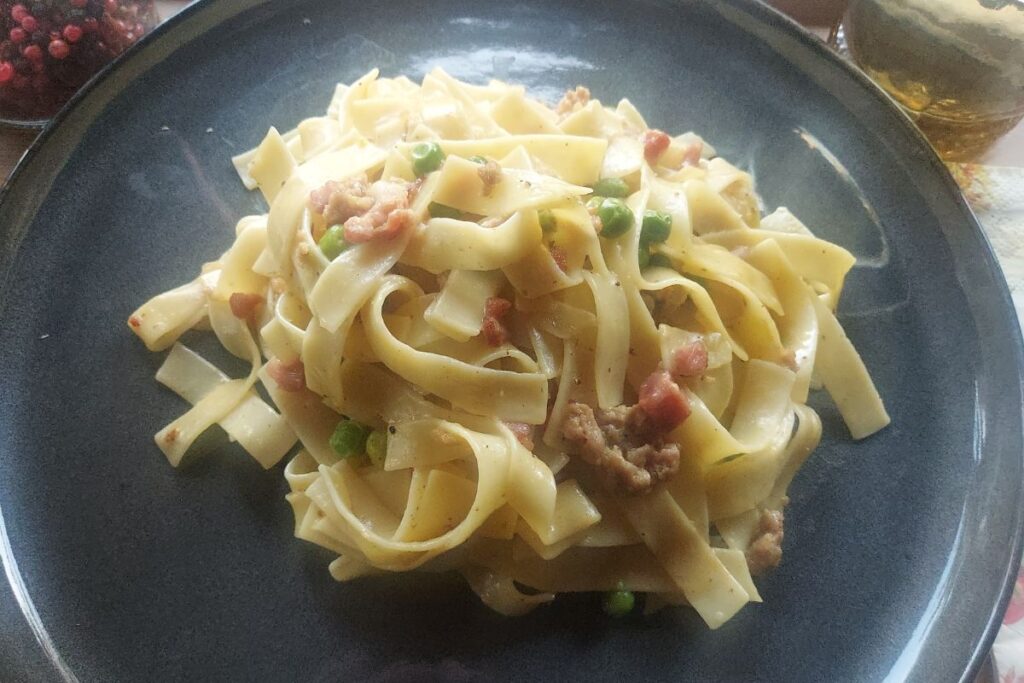
This isn’t an authentic Roman carbonara. I add onion. I add garlic. I add peas. And quite often I’ll squeeze one or two plain sausages out of their casings and throw those in with the pancetta too.
I know.
But I’m completely fine with that because I’m not trying to recreate a restaurant dish or claim that this is how carbonara should be made. It’s simply how I make it at home, and there’s actually a reason behind some of those additions.
Pasta already gives me plenty of carbohydrates, but I like this dinner to have a little more protein and to keep everyone full. The extra sausage helps with that, and the peas do two jobs at once. They add a little more protein, but importantly for me, they also bring some fibre into a meal that otherwise doesn’t have very much of it, and my boys can definitely eat. This version actually fills them up.
So Where Does the Name Carbonara Come From?
For a dish people have such strong opinions about, even the origin of the name isn’t completely clear.
Carbonara isn’t connected to carbohydrates, despite pasta doing a very good job of providing plenty of those. The name is generally associated with the Italian word carbone, meaning coal.
One explanation links the dish to carbonari, or charcoal workers. Another theory is much more visual: all that freshly ground black pepper scattered over the pale pasta was said to resemble little specks of coal dust.
There are different stories about the origins of the dish itself too. Carbonara as we know it today appears to be relatively modern, becoming documented around the Second World War and the years that followed. One theory even connects its development with American soldiers in Italy and ingredients such as bacon and eggs meeting Italian pasta.
Which makes all the arguments about the one and only correct carbonara even more entertaining to me.
Apparently Even Italians Argue About Carbonara
Years ago, I remember reading the comments underneath a carbonara video on YouTube. The Italians in the comments were arguing about how carbonara was really supposed to be made.
Whole eggs or just yolks? Pancetta or another type of cured pork? Someone said it depended on the region, somebody else disagreed, and the discussion just kept going. It was actually quite funny to read.
Then one comment basically ended the whole argument for me.
The person pointed out that carbonara was originally a simple, humble dish. The idea mattered more than obsessing over every single ingredient, and people would have cooked with what they had. They also made the very practical point that ordinary people weren’t necessarily going to throw perfectly good egg whites away.
I don’t remember who wrote that comment anymore, and I can’t tell you whether their version of carbonara history was completely accurate. But I remember the idea because it made sense to me.
And that’s pretty much how I’ve approached carbonara ever since.
Why This 20 Minute Carbonara Is My Backup Dinner
I usually make carbonara precisely when I don’t have a dinner plan. It’s inexpensive, it’s filling, and most of the ingredients are things I tend to have anyway. If there’s pancetta, brilliant. Bacon works too. If I have a couple of plain sausages, they can go in. Tagliatelle is usually my first choice, but if there isn’t any, spaghetti does the job.
That’s the whole point of a backup dinner. I don’t want to discover at 6 pm that my supposedly quick recipe requires three ingredients I don’t have.
My parents used to make something similar when I was growing up in Poland, although without Parmesan. Parmigiano wasn’t exactly an everyday ingredient in Polish kitchens back then. So I suppose there have always been different versions of this kind of pasta around me. At its simplest, we’re talking about pasta, meat and eggs, and people naturally make that combination their own.
One Thing I Don’t Add: Cream
I’ve heard friends say they don’t particularly like ordering carbonara in restaurants because sometimes it arrives with cream in the sauce. For them, that completely ruins it.
I’ve actually never eaten anyone else’s proper homemade carbonara, so I can’t enter that debate with much authority. But I do know how I like mine 20 minute carbonara, and I don’t use cream.
The eggs are the sauce.
I whisk them with a fork, add them to the pasta only after I’ve switched off the heat, then mix everything thoroughly with the Parmigiano Reggiano. If it looks a little too dry, some of the pasta water loosens everything up. That’s enough to give me the creamy coating I want without adding cream.
And that’s really all this dinner needs to be.
It’s not my authentic Italian carbonara. It’s the carbonara I make when I’m tired, I’m short on time, the family needs feeding and I still want something homemade on the table.
Twenty minutes, one very full pan, and everyone is fed.
That’s exactly why I keep making it.
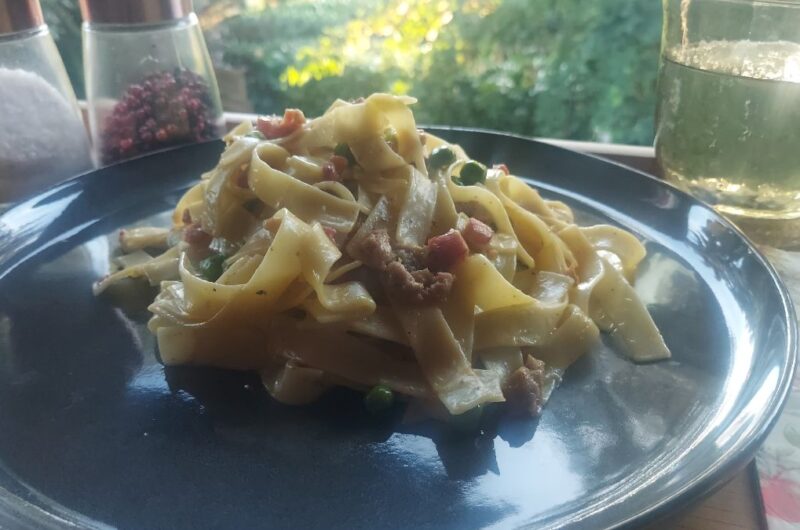
My 20 Minute Carbonara for Days I Don’t Feel Like Cooking
Course: Main CourseCuisine: Italian-inspiredDifficulty: Easy4
servings5
minutes15
minutes720
kcalIngredients
300 g tagliatelle or spaghetti
250 g pancetta or bacon
Optional: 1–2 plain Cumberland-style sausages, casings removed
2 tbsp olive oil
1 small onion, diced
1 garlic clove, finely chopped or crushed
1 handful fresh or frozen peas
3–4 eggs
Parmigiano Reggiano
Salt
Freshly ground black pepper
Pasta cooking water, as needed
Directions
- Start the pancetta and sausage.
Heat the olive oil in a large frying pan. Add the diced onion and pancetta. If using the sausage, squeeze the meat out of the casing directly into the pan and break it into small pieces with a fork. - Cook until lightly browned.
Cook over medium heat until the onion has softened, the fat from the pancetta and sausage has rendered, and the meat is lightly browned around the edges. - Add the peas.
Add a handful of frozen peas and continue cooking until the peas are tender. - Cook the pasta.
Meanwhile, cook the tagliatelle or spaghetti in a separate pan according to the packet instructions. Before draining, reserve some of the pasta cooking water. - Bring everything together.
Once the peas are cooked, add the drained pasta directly to the frying pan with the pancetta mixture and toss everything together. - Add the eggs off the heat.
Turn off the heat completely. Pour the whisked eggs over the pasta and immediately toss everything thoroughly so the eggs coat the hot pasta and create a creamy sauce rather than scrambling. - Add the Parmigiano.
Add the grated Parmigiano Reggiano and mix thoroughly. If the sauce feels too dry, add a little reserved pasta water at a time until it’s as creamy as you like it. - Season and serve.
Season with salt and plenty of freshly ground black pepper, taste and adjust if needed.
Season and serve.
Notes
- Pasta: I usually use tagliatelle, but spaghetti works just as well. Before draining, reserve some of the pasta water in case you need it for the sauce.
Pancetta or bacon: Either works. I also sometimes add 1–2 plain sausages, removed from their casings and broken into small pieces, for a more filling version with extra protein.
Eggs: Add the whisked eggs only after turning off the heat. The residual heat from the pasta and pan is enough to create a creamy coating without scrambling the eggs.
Pasta water: If the carbonara looks too dry after adding the eggs and Parmigiano Reggiano, add a little reserved pasta water at a time until you reach the consistency you like.
Salt: Taste before adding too much. Pancetta, bacon and Parmigiano Reggiano are already salty, so you may need very little additional salt.
Serve immediately: Carbonara is at its best straight from the pan while the sauce is still creamy.