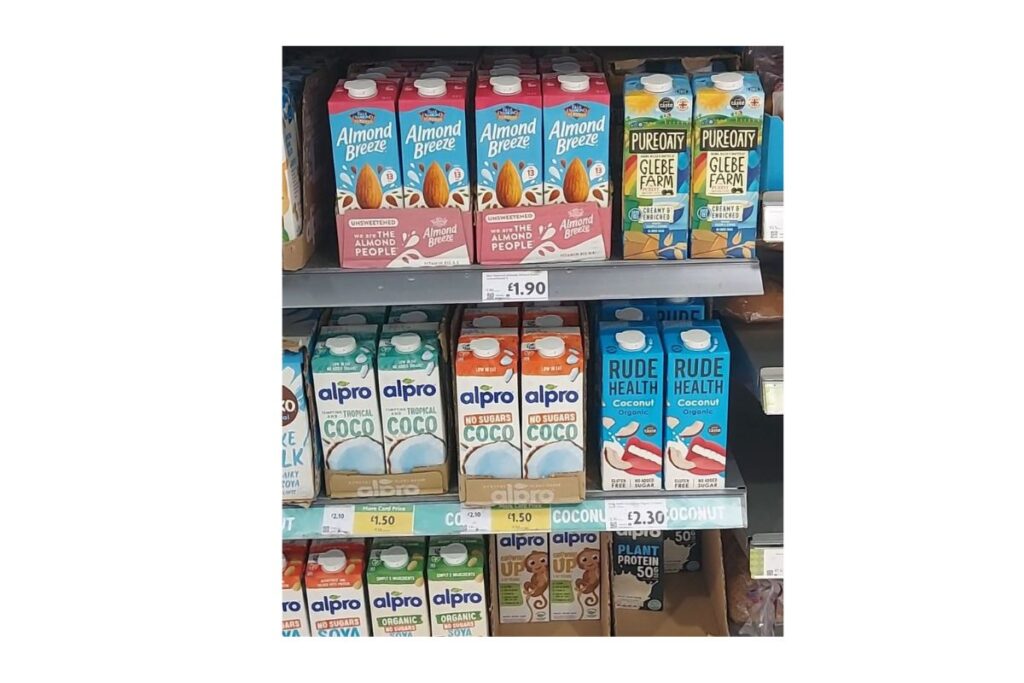
Come sit with me. We need to talk about the carton in your fridge.
Because once you know what’s in plant milk, that carton starts to look a little different.
I’m not here to tell you to go back to dairy. I’m not here to tell you plant milks are bad. But I do think you deserve to know what you’re actually pouring into your coffee every morning — because it’s probably not what the label suggests.
Let’s start there.
It’s mostly water
When you pick up a carton of almond milk, you might picture something like blended almonds and water. Clean, simple, natural. The reality? Most almond milk brands contain as little as 2% almonds. Across plant milks broadly, the main ingredient — oats, almonds, whatever’s on the front — makes up somewhere between 2% and 16.5% of what’s in the carton. The rest is water, and then a few other things manufacturers add to make it taste and behave like milk.
Those things include stabilisers like gellan gum, guar gum, xanthan gum, and lecithin. They’re not harmful — regulators consider them safe, and they’ve been used in food for years. But research is beginning to ask more questions. A study published in the journal Microbiome tested 20 commonly used emulsifiers on human gut microbiota and found that various gums and carrageenans altered gut bacteria density, composition, and triggered pro-inflammatory signals. Most of this research has been in animal models so far, and we don’t yet have the full picture for humans. But if you already have gut issues or a sensitive digestive system, it’s worth knowing these ingredients are in your daily drink.
Many plant milks also contain added oils — rapeseed or sunflower — to improve the mouthfeel and stop the liquid tasting thin and watery. The amounts are small. But if you’re drinking plant milk every day, in coffee, on cereal, in your child’s cup, it adds up. Rapeseed is one of the most heavily sprayed crops in conventional farming and the oil goes through intensive industrial refining — high heat, bleaching, deodorising — before it reaches the carton. Sunflower oil, meanwhile, has an omega-6 to omega-3 ratio of 632:1, in a world where most of us are already eating far too much omega-6 and not nearly enough omega-3.
We’ll cover both oils properly in their own articles — there’s a lot to say. But for now, if you can find a plant milk without added oils, that’s worth choosing.
A UK study found that 97% of non-organic plant milks are classified as ultra-processed. That’s not a reason to avoid them. It is a reason to read past the front of the carton.
About that sugar
Here’s something that catches people off guard. “Unsweetened” doesn’t always mean what you think it means.
Oat milk is the one I’d flag most. Oats contain starch, and during processing, enzymes break some of that starch down into sugar — particularly maltose. So oat milk can have several grams of sugar per serving even when nothing has been added. Rice milk is similar, often higher.
Almond milk and soy milk? Generally much lower in sugar, especially unsweetened versions, because almonds and soybeans naturally contain less carbohydrate to begin with.
Two cartons sitting next to each other on the shelf can look almost identical and have completely different sugar profiles. Read the label, not just the front.
Protein: where the gap really shows
This is the part that matters most if you’re using plant milk daily — for breakfast, in cooking, or for children.
Cow’s milk naturally provides complete protein, meaning it contains all the essential amino acids your body needs. Most plant milks don’t come close.
Soy milk is the exception — it typically provides around 6–8g of protein per serving and is nutritionally the closest match to dairy. Pea milk is similar. Oat milk sits around 2–4g. Almond milk? Often just 1g. Rice milk, even less.
If you’re giving a young child plant milk as a main drink and not thinking about where their protein is coming from elsewhere, this gap is worth knowing about.
Nutrition in early childhood is about much more than individual nutrients — I explore how these foundations develop in Why the First 1000 Days Matter.
The nutrient nobody talks about: iodine
Calcium, vitamin D, vitamin B12 — these get all the attention. And yes, many brands now fortify for those. But iodine is the one that quietly slips through.
Cow’s milk is the primary source of iodine in the UK diet, and most plant-based milk alternatives are not fortified with iodine. Certain groups — particularly pregnant women, women of reproductive age, and those eating vegan diets — remain at real risk of iodine deficiency. Iodine matters for thyroid function and, critically, for brain development in babies during pregnancy.
Some brands — Oatly, Alpro, and supermarket own-brands like ASDA and M&S — do now include iodine in their fortification. But many still don’t, and there’s no requirement for them to. If you’re pregnant, breastfeeding, or replacing most of your dairy with plant milks, check the label specifically for iodine. Don’t assume it’s in there.
A word about those added vitamins
This is the part that doesn’t get talked about enough.
When a carton says “fortified with calcium, vitamin D, and B12,” it sounds reassuring. And I don’t want to dismiss it entirely — fortification is better than nothing, and some brands do it thoughtfully. But there are a few things worth knowing before you assume you’re covered.
Start with vitamin D. Dairy milk is typically fortified with D3 — the form your body uses most effectively. Many plant milks, however use D2, because D3 is usually derived from lanolin — sheep’s wool — making it unsuitable for vegan products. Randomised controlled trials show that vitamin D3 is bioavailable from many foods, while D2 bioavailability varies considerably depending on the food it’s in. So if your plant milk is fortified with D2 and you’re relying on it as a meaningful source of vitamin D, the reality may be that less of it is actually reaching you than the label implies.
Some brands now use a vegan D3 derived from lichen — that’s the one to look for. It’s not common yet, but it exists.
Calcium is more complicated. The form matters — calcium carbonate absorbs reasonably well and is comparable to dairy calcium, while tricalcium phosphate absorbs less effectively. But there’s another problem: there is evidence that the minerals added to plant-based milks can precipitate out of the solution — essentially settling to the bottom — meaning each serving may not actually deliver what the label promises. This is why shaking the carton before you pour actually matters more than most people realise.
There’s also research suggesting that high levels of added calcium in plant milks may actually reduce vitamin D absorption, because the calcium forms insoluble compounds in the small intestine that interfere with it. So the two things being fortified together may partially work against each other — which is not something anyone puts on the front of the carton.
The bigger picture is this: naturally occurring nutrients in whole foods come packaged with everything the body needs to recognise and absorb them — the cofactors, the fats, the food matrix. When you isolate a nutrient, add it to water, and put it in a carton, it doesn’t behave the same way. That doesn’t make fortification worthless. But it does mean that someone drinking oat milk every day and ticking the calcium and vitamin D boxes in their head may be getting significantly less than they think.
If you’re relying on plant milk as your main source of these nutrients, it’s worth either choosing brands carefully — looking for D3 (vegan, from lichen), calcium carbonate rather than tricalcium phosphate, and always shaking before pouring — or making sure you’re getting these nutrients from other sources too. Sunlight for vitamin D. Whole food sources of calcium like sesame, almonds, leafy greens, sardines if you eat them. Real food, not just reassuring numbers on a carton.
So What Should You Look for When Checking What’s in Plant Milk?
When you’re choosing a plant milk, the front of the carton is mostly marketing. The back is where the actual information lives.
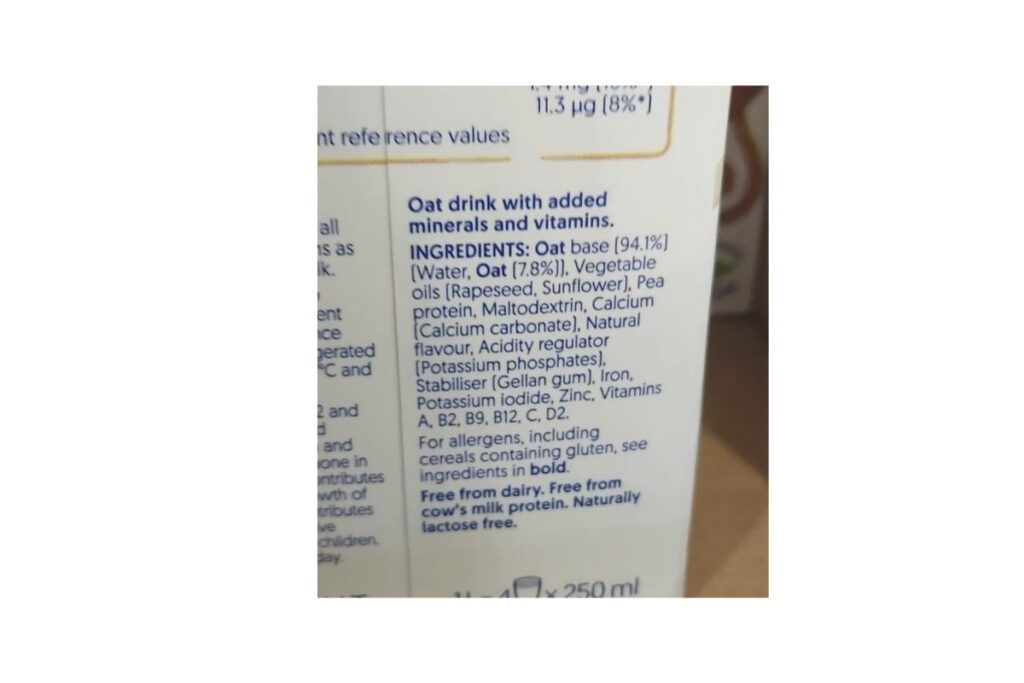
I look for:
- Calcium — around 120mg per 100ml, similar to dairy
- Vitamin B12 — around 0.5 micrograms per 100ml
- Vitamin D — at least 1 microgram per 100ml
- Iodine — listed specifically in the nutrition panel
- Sugar content — especially in oat and rice milks
- Protein — matters more if it’s a daily milk for children or used as a main source
- No added oils — where possible, choose brands that don’t need them
A shorter ingredients list is nearly always a better sign.
What’s in Plant Milk — and Is It Healthy?
Yes — they can absolutely be part of a healthy diet. For people with dairy allergies, lactose intolerance, or those choosing to eat less animal produce, they’re a useful and often delicious option. I use them myself.
But “plant-based” doesn’t automatically mean nutritious. And “natural” doesn’t mean unprocessed.
The best plant milk is the one that fits your actual needs — and that you’ve actually read the label on.
That’s where it starts.
— Jo
References
If you’d like to read further, here are the studies behind this article:
Iodine in plant milks — the key UK
Vitamin D2 vs D3 — which form actually works
Calcium form matters — carbonate vs tricalcium phosphate
Calcium reducing vitamin D absorption in plant milks
Iodine status of plant milk consumers vs dairy drinkers — UK national data